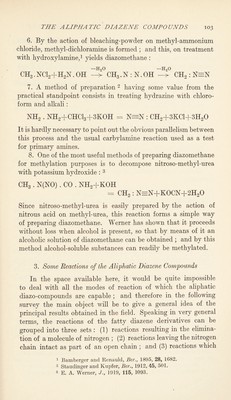
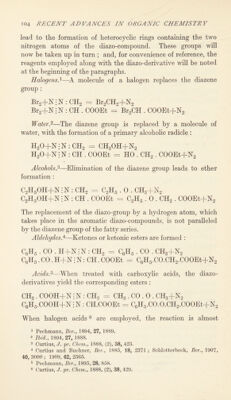
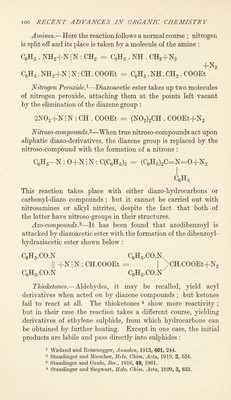
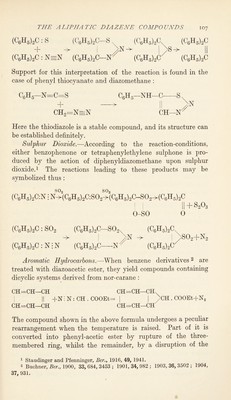
Volume 1
Recent advances in organic chemistry / by Alfred W. Stewart.
- Alfred Walter Stewart
- Date:
- 1931
Licence: Attribution-NonCommercial 4.0 International (CC BY-NC 4.0)
Credit: Recent advances in organic chemistry / by Alfred W. Stewart. Source: Wellcome Collection.
116/452 (page 98)
![from the same two atoms as in the cyclic case. Obviously this reaction is equally usefu] on either side of the controversy. An examination of the absorption spectra of the aliphatic diazo-compounds led Hantzsch and Lifschitz 1 to the conclusion that the ring-structure was the best representation of these substances; but nowadays evidence drawn from absorption spectra is hardly allowed the weight which was lent to it at one time. Curiously enough, the best argument in favour of the cyclic structure is furnished, not by the diazene compounds themselves, but by the azoimides. These compounds can be obtained from nitrosohydrazines by elimination of water : B-N< .NIL N:0 -h2o ,N > K—N< XN This reaction seems to prove the existence of the azo-group —N : N—as part of a three-membered ring ; and if it can exist in the azoimides, it might equally be found in the diazene series which resemble the azoimides in several respects. One of the strongest arguments against the cyclic structure, however, has yet to be mentioned. The aliphatic diazo-com¬ pounds readily unite with many substances to form heterocyclic derivatives wherein two nitrogen atoms play the part of adjacent members of the rings. Now an inspection of the formulae below will show that in the open-chain structure, such a reaction could take place by simple attachment of two ends of a carbon chain to the atoms marked with asterisks. In the case of the cyclic * * HoC=NeeN ,N 'N formula, on the other hand, the ring must first be ruptured ; and if the two nitrogen atoms are to be left united to each other, this break-up must occur at the dotted line. In other words, though on all normal ideas the double bond of the —N : N— group would furnish the point of attack of a fresh reagent, it is kept intact and a single linkage between two atoms is broken instead. A concrete example will make the matter clear. Diazomethane 1 Hantzsch and Lifschitz, Ber., 1912, 45, 3022.](https://iiif.wellcomecollection.org/image/b2992814x_0001_0118.jp2/full/800%2C/0/default.jpg)