The nature of inflammation, and the principles on which it should be treated, examined from a common sense point of view / by Thomas Inman. To which is added, A history of atheroma in arteries, its nature and alliances, showing the bond of union between consumption, aneurism, apoplexy, scrofula, and fatty degenerations of the heart and other organs.
- Thomas Inman
- Date:
- [1860?]
Licence: Public Domain Mark
Credit: The nature of inflammation, and the principles on which it should be treated, examined from a common sense point of view / by Thomas Inman. To which is added, A history of atheroma in arteries, its nature and alliances, showing the bond of union between consumption, aneurism, apoplexy, scrofula, and fatty degenerations of the heart and other organs. Source: Wellcome Collection.
Provider: This material has been provided by The Royal College of Surgeons of England. The original may be consulted at The Royal College of Surgeons of England.
21/68 page 17
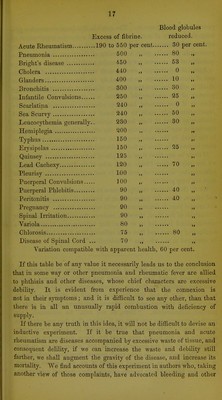
![Blood globules Excess of fibriue. reduced. Acute Rheumatism 190 to 560 per cent 30 per cent. Pneumonia 500 , 80 ,, Bright's disease '^50 „ 53 „ Cholera 440 0 Glanders 400 „ 10 Bronchitis 300 „ 30 Infantile Convulsions 250 „ 25 „ Scarlatina 240 „ 0 Sea Scurvy 240 „ 50 Leucocythemia generally.. 230 , 30 „ Hemiplegia 200 ,, „ Typhus 150 „ Erysipelas 150 „ 25 „ Quinsey 125 ,, Lead Cachexy 120 , 70 Pleurisy 100 „ Puerperal Convulsions ] 00 „ Puerperal Phlebitis 90 „ 40 Peritonitis 90 „ 40 Pregnancy 90 ,, „ Spinal Irritation 90 ,, Variola 80 , „ Chlorosis 75 , 80 „ Disease of Spinal Cord ... 70 „ „ Variation compatible with apparent health, 60 per cent. If this table be of any value it necessarily leads us to the conclusion that in some way or other pneumonia and rheumatic fever are allied to phthisis and other diseases, whose chief characters are excessive debility. It is evident from experience that the connexion is not in their symptoms; and it is difficult to see any other, than that there is in all an unusually rapid combustion with deficiency of supply. If there be any truth in this idea, it will not be difficult to devise an inductive experiment. If it be true that pneumonia and acute rheumatism are diseases accompanied by excessive waste of tissue, and consequent delility, if we can increase the waste and debility still farther, we shall augment the gravity of the disease, and increase its mortality. We find accounts of this experiment in authors who, taking another view of those complaints, have advocated bleeding and other](https://iiif.wellcomecollection.org/image/b22286536_0023.jp2/full/800%2C/0/default.jpg)

 No text description is available for this image
 No text description is available for this image
 No text description is available for this image