Abstract of 'Researches on magnetism and on certain allied subjects', including a supposed new imponderable / By Baron von Reichenbach. Translated and abridged from the German by William Gregory.
- Carl Reichenbach
- Date:
- 1846
Licence: Public Domain Mark
Credit: Abstract of 'Researches on magnetism and on certain allied subjects', including a supposed new imponderable / By Baron von Reichenbach. Translated and abridged from the German by William Gregory. Source: Wellcome Collection.
27/128 page 15
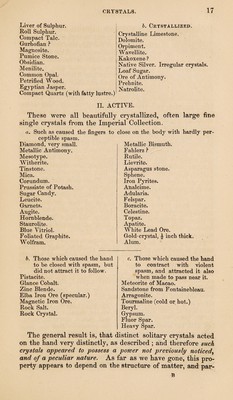
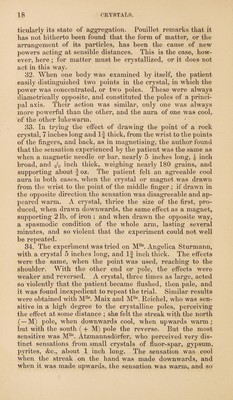
![who laughed at it to be absurd, impossible, and inexplicable. It is still as inexplicable as ever, but I do not think we can ra¬ tionally doubt the fact: and I would take this opportunity of pointing out, as I have formerly done elsewhere, that in mat¬ ters of observation, especially when new, the only question is this, “ Is it true ?” and not, “ Is it possible 1” or “ Is it not absurd V’ We cannot say what is possible, and no fact can be absurd. That we cannot explain it is only what might be expected, if we consider that multiplied observations are necessary before we can properly attempt to trace those general laws, which we often call explanations, when they are only statements of the facts in a new form. Newton’s law of gravitation does not explain the facts: it only aids our comprehension of them. I repeat that we have here one of the most ridiculed facts of mesmerism established, independent of mesmerism, by simple observation; and this ought to teach caution to those who denounce the whole of Mesmerism as imposture.—W. G.] 28. The author was still more surprised to find that not only the magnet, but a magnetised glass of water, possessed the property of attracting the hand of Mlle. Nowotny. This took place in an inferior degree, but the hand never failed to shew a tendency to follow the magnetised water, whether the patient were in a state of catalepsy or not. 29. Being convinced that such a phenomenon could not be an isolated one, the author tried, whether the same effect might not be produced by other bodies besides water, hoping, if this were so, to be enabled to trace some general laws. All sorts of minerals, preparations, drugs, in short, objects of all kinds were therefore magnetised in the same way as the water, by drawing or passing the magnet along them, and tried on the patient; and all of them had acted as the water had done, more or less powerfully. Some of them caused spasms over the whole body, others only in the arm, others again only in the hand, and, lastly, others not at all, although all were equally magnetised. It was clear that a difference existed in the different kinds of matter, which here came into operation. 30. To investigate this, the same substances were tried, without being previously magnetised, in their natural condi¬ tion. To his astonishment they still acted on the patient, and that with a power often little inferior to that which they had when magnetised. They did not, however, always give to the hand a tendency to follow, but more frequently caused it, as described in § 25, to grasp the magnet convulsively, with various degrees of force. It was also observed that the effect in](https://iiif.wellcomecollection.org/image/b30351017_0027.jp2/full/800%2C/0/default.jpg)