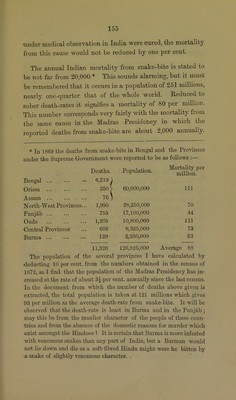
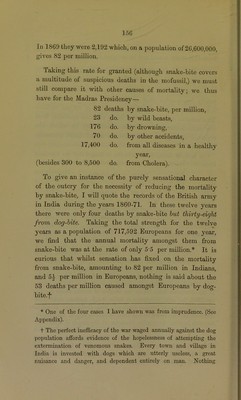
Indian snakes : an elementary treatise on ophiology with a descriptive catalogue of the snakes found in India and the adjoining countries / by Edward Nicholson.
- Nicholson, Edward
- Date:
- 1893
Licence: Public Domain Mark
Credit: Indian snakes : an elementary treatise on ophiology with a descriptive catalogue of the snakes found in India and the adjoining countries / by Edward Nicholson. Source: Wellcome Collection.
206/246 page 152
![evident that neutralization of the faintly acid cobra-poison is quite ineffectual, for it is as readily neutralized by ammonia as by potash; but as the former alkali has no tendency to destroy it, cobra-poison mixed with Liquor ammonise shows no diminution of activity whilst that mixed with Liquor potassre may show an appreciable diminution. If further proof were needful, I might mention that the blood is sufficiently alkaline of itself to neuturalize the acidity of any amount of cobra-poison* The last antidote proposed is to the effect that artificial respiration and galvanism has been tried with success in dogs affected by cobra-poison. This is evidently on the theory that cobra-poison acts by paralyzing the respiratory muscles and that artificial respiration will enable the patient to tide over the crisis until the poison becomes naturally eliminated. This idea, borrowed from Mr. Waterton’s experiments with the * It may appear singular that a medical man should fall into the error of supposing that the secretion of a salivary gland could consist principally of an acid capable of being rendered inert by neutraliza- tion with an alkali. But really what can we expect when we find that Dr. Shortt’s notions on the gland and its secretion are so vague that he imagines the former to be a little bag situated at the base of the fang, capable of being removed not only without injury to the snake but without any trace of the operation being visible except on the closest scrutiny, and also capable of reproduction so perfectly that the operation can be repeated once a month. (M. M. J., Nov. 1871, pages 346 and 347.) That this gentleman should have neglected to prepare himself for his experiments by some study of ophiology is so little credible that I quote the passages :—“ Some [snake charmers] go further and cut out that portion of the jaws which contains the poison gland.”—“ My curiosity being excited, I examined the mouth of the snake again more carefully, and found a small cicatrix at the base and a little beyond the fang, and a more scruti- nizing examination discovered to me that the entire poison gland had been removed, although the fangs were left unmolested : and I also learned that this operation of removing the poison gland is resorted to once a month and that it was effected by an iron style.”](https://iiif.wellcomecollection.org/image/b28051609_0206.jp2/full/800%2C/0/default.jpg)