Licence: Public Domain Mark
Credit: On sugar in the urine / by H. Bence Jones. Source: Wellcome Collection.
Provider: This material has been provided by The Royal College of Surgeons of England. The original may be consulted at The Royal College of Surgeons of England.
8/26 page 8
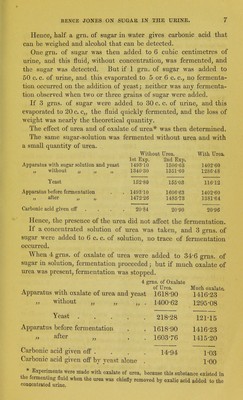
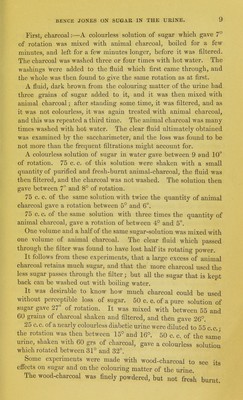
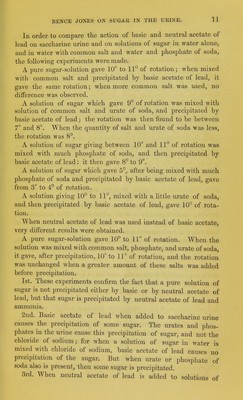
![Hence, with much oxalate, the fermentation was almost entirely stopped. O71 the comparison of the delicacy of the Fermentation-test, and with Fehlinff's standard solution. A watery solution of grape sugar was prepared which gave a solution of 104° = 2*288 grains of sugar in each cubic centimetre.* 15 c. c. of this solution = 34*25 grains of sugar were fermented with yeast that had been once washed. A second experiment was made with the same quantities, and a third experiment was made to determine the carbonic acid in the yeast:— 1st Experiment. 2nd Experiment. 3rd Experiment. Yeast employed . 263-90 270-66 210-15 Carbonic acid given oflP 18-29 18-70 0-62 Carbonic acid in yeast 0-76 0-78 Carbonic acid in sugar 17'53 17-92 Hence sugar in each c.c. of solution =2-376 grains=2-437 grains 10 c. c. of the same solution were diluted to 160 c.c, and tested by fresh prepared Fehling's solution. 10 c, c. of Pehling's solution were reduced by 5-6 c.c. of the diluted sugar solution. Hence 10 c. c. of the solution before dilution contained 21-9 grains sugar, and each c. c. contains 2'] 92 grains sugar. Hence in each cubic centimeter of the solution there were present:— By fermentation, 2-371 and 2-437 grs. sugar mean = 2-356 gi's. By saccharimeter .... 2-288 grs. By copper test .... 2-192 grs. On SoleiVs Saccharimeter. Before the saccharimeter can be used, the fluid about to be examined must be decolorised. To effect this, animal charcoal, acetate or subacetate of lead and ammonia, or chlorine gas must be used. These substances, whilst removing the colour, keep back or destroy some of the sugar, and it was desirable therefore to determine the loss. * This number is obtained by making a solution of sugar which contains .01 gramme of sugar in each cubic centimetre when examined by Fehling's soluUon. This amount of sugar in solution gives seven degrees of rotation.](https://iiif.wellcomecollection.org/image/b22321500_0010.jp2/full/800%2C/0/default.jpg)



 No text description is available for this image
 No text description is available for this image
 No text description is available for this image