Licence: Public Domain Mark
Credit: On the presumption of survivorship / by James Bell Pettigrew. Source: Wellcome Collection.
Provider: This material has been provided by the Royal College of Physicians of Edinburgh. The original may be consulted at the Royal College of Physicians of Edinburgh.
17/38 (page 187)
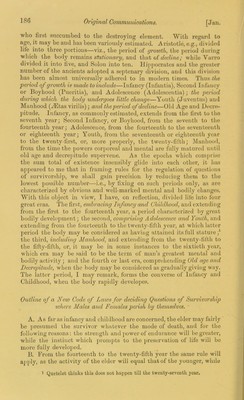
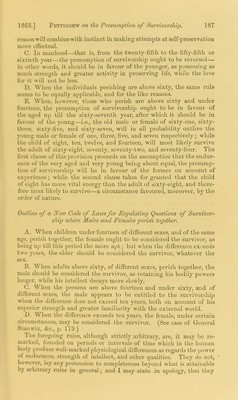
![reason will combine with instinct in making attempts at self-preservation more efiectiial. C. In manhood—that is, from the twenty-fifth to the fifty-fifth or sixtieth year—the presumption of survivorship ought to be reversed— in other words, it should be in favour of the younger, as possessing as much strength and greater activity in pre.serving life, while the love for it will not be less. D. When the individuals perishing are above sixty, the same rirle seems to be equally applicable, and for the like reasons. E. When, however, those who perish are above sixty and under fourteen, the presumption of survivorship ought to be in favour of the aged up till the sixty-seventh year, after which it should be in favour of the young—i.e., the old male or female of sixty-one, sixty- three, sixty-five, and sixty-seven, will in all probability outlive the young male or'female of one, three, five, and seven respectively; while the child of eight, ten, twelve, and fourteen, will most likely survive the adult of sixty-eight, seventy, seventy-two, and seventy-four. The fimt clause of this provision proceeds on the assumption that the endur- ance of the very aged and very young being about equal, the presump- tion of survivorship ■will be in favour of the former on account of experience; while the second clause takes for granted that the child of eight has more vital energy than the adult of sixty-eight, and there- fore most likely to survive—a circumstance favoured, moreover, by the order of natm-e. Oidline of a New Code of Laws for Regulating Questions of Survivor- ship where Males and Females pendsh together. A. When children under fourteen of different sexes, and of the same age, perish together, the female ought to be considered the survivor, as being u]) till this period the more apt; but when the difference exceeds two yeai*s, the eider should be considered the survivor, whatever the sex. B. When adults above sixty, of different sexes, perish together’, the male should be considered the survivor, as retaining his bodily powers longer, while his intellect decays more slowly. C. When the persons are above fourteen and under sixty, and of different sexes, the male appears to be entitled to the survivorship wlien the difference does not exceed ten years, both on account of his superior strength and greater familiarity with the external world. 1). Wlien the difference exceeds ten years, the female, under certain circumstances, may be considered the survivor. (See case of General Staiiwix, (fee., p. 179.) The foregoing rules, although strictly arbitrary, are, it may bo re- marked, founded on periods or intervals of time vvhicli in the human body produce well-marked [)hysiological differences as regards the power of endurance, strength of intellect, and other qualities. They do not, however, lay any pretension to completeness beyond what is attainable by arbitrary rules in general; and 1 may state in apology, that they](https://iiif.wellcomecollection.org/image/b21955876_0019.jp2/full/800%2C/0/default.jpg)