Licence: Public Domain Mark
Credit: Bengal public health report. Source: Wellcome Collection.
82/370 page 72
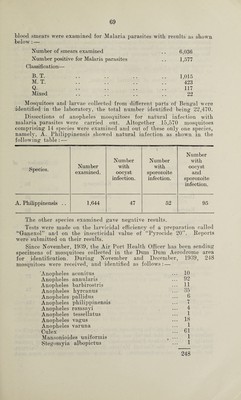
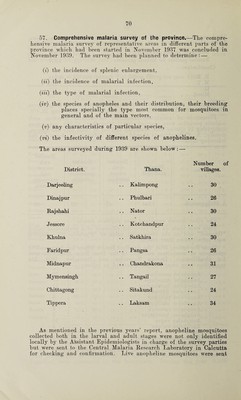
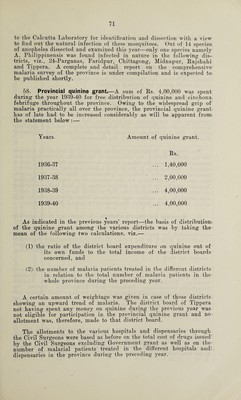
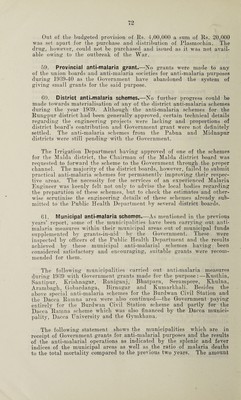
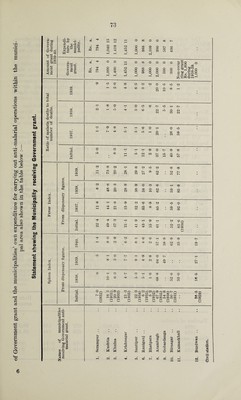
![Out of tlie budgetecl provision of Es. 4,00,000 a sum of Rs. 20,000 was set apart for the purchase and distril)ution of Plasmochin. The drug, however, could not be purchased and issued as it was not avail¬ able owing to the outbreak of the War. 59. Provincial anti-malaria grant.—IN^o grants were made to any of the union boards and anti-malaria societies for anti-malaria purposes during 1939-40 as the Government have abandoned the system of giving small grants for the said purpose. 60. District anti-malaria schemes.—No further progress could be made towards materialisation of any of the district anti-malaria schemes during the year 1939. Although the anti-malaria schemes for the Rungpur district had been generally approved, certain technical details regarding the engineering projects were lacking and proportions of district board’s contribution and Government grant were not definitelv settled. The anti-malaria schemes from the Pabna and Midnapur districts were still pending with the Government. The Irrigation Department having approved of one of the schemes for the Malda district, the Chairman of the Malda district board was requested to forward the scheme to the Government through the proper channel. The majority of the district boards, however, failed to submit practical anti-malaria schemes for permanently improving their respec¬ tive areas. The necessity for the services of an experienced Malaria Engineer was keenly felt not only to advise the local bodies regarding the preparation of these schemes, but to check the estimates and other¬ wise scrutinise the engineering details of these schemes already sub¬ mitted to the Public Health Department by several district boards. 61. Municipal anti-malaria schemes.—As mentioned in the previous years’-report, some of the municipalities Lave been carrying out anti¬ malaria measures within their municipal areas out of municipal funds supplem.ented by grants-in-aid ])y the Government. These were inspected by officers of the Public Health Department and the results achieved by these municipal anti-malarial schemes having been considered satisfactory and encouraging, suitable grants were recom¬ mended for them. The followung municipalities carried out anti-malaria measures during 1939 with Government grants made for the purpose:—Kusthia, Santipur, Krishnagar, Raniganj, Bhatpara, Serampore, Khulna, Arambagh, Gobardanga, Birnagar and Kumarkhali. Besides the above special anti-malaria schemes for the Burdw'an Civil Station and the Dacca Ramna area were also continued—the Government paying entirely for the Burdwan Civil Station scheme and partly for the Dacca Ramna scheme which was also financed by the Dacca munici¬ pality, Dacca University and the Gymkhana. The following statement shows the municipalities wffiich are in receipt of Government grants for anti-malarial purposes and the results of the anti-malarial operations as indicated by the splenic and fever indices of the municipal areas as well as the ratio of malaria deaths to the total mortality compared to the previous two years. The amount](https://iiif.wellcomecollection.org/image/b31406543_0082.jp2/full/800%2C/0/default.jpg)
 No text description is available for this image
 No text description is available for this image
 No text description is available for this image