Lectures on the principles and practice of medicine / Delivered in Chicago Medical College, Medical Department of the Northwestern University, by Nathan Smith Davis.
- Nathan Smith Davis
- Date:
- 1884
Licence: Public Domain Mark
Credit: Lectures on the principles and practice of medicine / Delivered in Chicago Medical College, Medical Department of the Northwestern University, by Nathan Smith Davis. Source: Wellcome Collection.
Provider: This material has been provided by the Augustus C. Long Health Sciences Library at Columbia University and Columbia University Libraries/Information Services, through the Medical Heritage Library. The original may be consulted at the the Augustus C. Long Health Sciences Library at Columbia University and Columbia University.
27/906 page 21
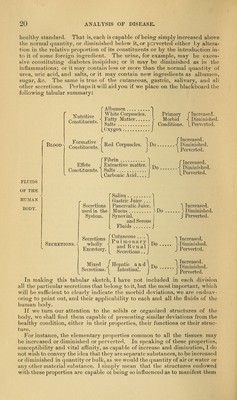
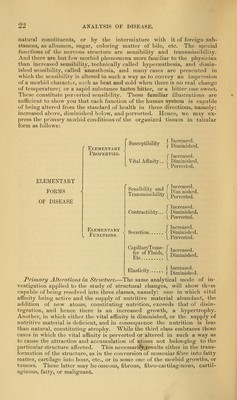
![in a greater or less degree of activity, or in some unusual direction. We see one person Avho either from hereditary or acquired influence, has become so easily aifected l)y ordinary external impressions, that the slightest atmospheric changes are liable to produce exaggerated effects. His sus- ceptibility is too great. Another presents directly the opposite. Neither atmospheric changes nor other excitants produce the ordinary influence, and we say his susceptibility is impaired. Again, we find one person with rich blood, active atomic or molecular changes, and not only active nutrition, secretion and calorification, but the slightest exudation into any of the structures or upon the membranous sur- faces, is rapidly organized into new tissue, causing- indurations, adhesions or increased growths. In such the play of vital affinity is manifestly increased above the normal standard. In surgical phrase, he has a hyper- plastic diathesis. In another person we may find the reverse of all this. The oi'dinary organic changes are slow ; nutrition, secretion, and calorifi- cation are but feebly maintained ; and if exuditions take place, instead of ra])id organization and acquisition of vitality, they degenerate, causirg softening of tissue, diffuse suppuration, and diminished nutrition or growtii. It is plain that in such we have impaired or feeble vital aiSnity, and pathol- ogists style it an aplastic diathesis. Ln still another case or class of cases, we find the molecular changes not merely increased or diminished, but so altered that atoms are attracted to and retained in tissues where they do not naturally belong, causing metamorphosis of tissue as when cartilage becomes bone, muscular fibre fatty tissue, &c. Or still further, causing the primary atoms or cells to be formed erroneously and to accumulate in the form of tumors or morbid growths. These are evidently all results of a perverted vital afiinity. The several alterations in the elementary prop- erties, constituting primary morbid conditions, may take place in all the tissues and organs at once, constituting a general morbid condition of the whole system ; or they may occur in only one tissue or organ constituting local predispositions and derangements. If the deviation is general and derived from hereditary influences, or acquired from causes acting feebly but continuously through a long period of time, the individual will present some one of those conditions called diatheses or predispositions, such as the plastic and aplastic, scrofulous, cancerous, rheumatic, gouty, &c. But if the causes act with more suddenness and intensity, producing more abrupt and exaggerated disturbance of the properties, there will result some one of the more acute forms of disease, such as fever, inflammation, or active irritation. l^rimary Alterations of Function.—The fact that the natural or healthy performance of any function depends on the coincidence of three things, namely: the proper arrangement of atoms constituting normal struc- ture, the endowment of the structure with the properties in their normal de- gree, and the presence of the proper stimulus in the normal proportion, it folhnvs that the failure or disturbance of either of these conditions must be follow^ed by corresponding failure or disturbance of function. And as I have just stated, that either or both of the elementary properties are capa- ble of being increased, diminished or perverted, so we may have the same primary deviation from the natural condition in any one or all of the functions in the human body. The function of the secreting structure is to separate from the blood certain materials in a fluid form, called a secretion. The secreting cells of the kidneys, for example, elaborate urine. And few things are more familiar than the fact that the quantity secreted in a given time maybe excessive or deficient, or it may be al- tered in quality—perverted, either by the omission of one or more of its](https://iiif.wellcomecollection.org/image/b21224572_0027.jp2/full/800%2C/0/default.jpg)
 No text description is available for this image
 No text description is available for this image
 No text description is available for this image