A historical relation of the plague at Marseilles in the year 1720 containing a circumstantial account of the rise and progress of the calamity, and the ravages it occasioned; with many curious and interesting particulars relative to that period / Translated from the French manuscript of Mons. Bertrand, physician at Marseilles who attended during the whole time of the malady, by Anne Plumptre, with an introduction and a variety of notes. By the translator.
- Jean-Baptiste Bertrand
- Date:
- 1805
Licence: Public Domain Mark
Credit: A historical relation of the plague at Marseilles in the year 1720 containing a circumstantial account of the rise and progress of the calamity, and the ravages it occasioned; with many curious and interesting particulars relative to that period / Translated from the French manuscript of Mons. Bertrand, physician at Marseilles who attended during the whole time of the malady, by Anne Plumptre, with an introduction and a variety of notes. By the translator. Source: Wellcome Collection.
54/424 page 20
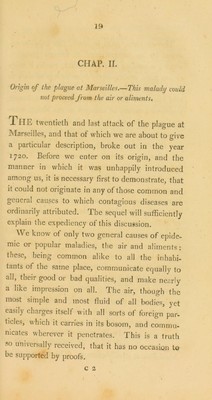
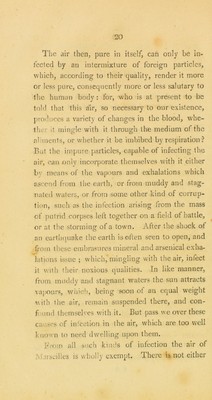
![The air then^ pure in itself, can only be In- fected by an intermixture of foreign particles, which, according to their quality, render it more or less pure, consequently more or less salutary to the human body: for, who is at present to be told that this am, so necessary to our existence, ])roduces a variety of changes in the blood, whe- ther it [uingle with it through the medium of the aliments, or whether it be imbibed by respiration ? But the impure particles, capable of infecting the air, can only incorporate themselves with it either by means of the vapours and exhalations which ascend from the earth, or from muddy and stag- nated waters, or from some other kind of corrup- tion, such as the infection arising from the mass of putrid corpses left together on a field of battle, ^ or at the storming of a town. After the shock of an earthquake the earth is often seen to open, and from these embrasures mineral and arsenical exha- lations issue ; which, mingling with the air, infect it with their noxious qualities. In like'manner, from muddy and stagnant waters the sun attracts vapours, Avhicf), being soon ot an equal weight with the air, remain suspended there, and con- found themseb’cs with it. But pass we over these causes of in lection in the air, which are too well known to need dwelling upon them. Frcnn all such kinds of infection the air of P Jarseilies is wholly exempt. There is not either](https://iiif.wellcomecollection.org/image/b22041916_0054.jp2/full/800%2C/0/default.jpg)
 No text description is available for this image
 No text description is available for this image
 No text description is available for this image