The Yelverton marriage case : Thelwall v. Yelverton : comprising an authentic and unabridged account of the most extraordinary trial of modern times, with all its revelations, incidents and details : specially reported.
- Avonmore, William Charles Yelverton, Viscount, 1824-1883.
- Date:
- 1861
Licence: Public Domain Mark
Credit: The Yelverton marriage case : Thelwall v. Yelverton : comprising an authentic and unabridged account of the most extraordinary trial of modern times, with all its revelations, incidents and details : specially reported. Source: Wellcome Collection.
Provider: This material has been provided by Royal College of Physicians, London. The original may be consulted at Royal College of Physicians, London.
111/198 page 107
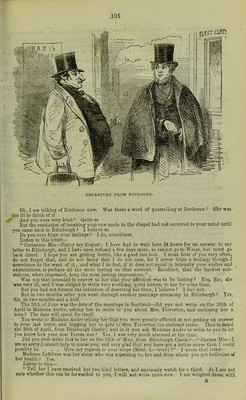
![-she waa Wtat time in Jlav ? About the latter end, I tliink. Mrs. Yelverton came to Edinburgh i> To Leith. I saw her theire. Is that the last letter you wrote to her (letter produced) ? Yes, that is the last letfori Counsel read the letter—“Poor little tooi-tooi—I cannot go and see you any more just now Fou muk go to Glasgow, as I asked,you. Do not forget the man’s name, Gilligan’s livery itables. My brother has come; I will send him to see you this afternoon about four o’clock, tddio.’’ Had you told her then why you could not go to see her ? The exact why, no, Sir. That you kept concealed ? The immediate step I was going to take' I did. You prevented her having the opportunity of preventing your marriage if she eould- ijiot on the spot ? She was. Sir. i You concealed that you were about to be married to another la(^ ? That I was going to be i narried so immediately. Sir, yes, I said I was going to be married. She taxed me about going to I le married. There were letters of mine to her previously, which she does not produce, that would duoidate the matter very much. ■Written from what place to what place.’’ Written from Edinburgh Castle to Boulogne'or Bordeaux. Take this letter in your hand'. [The letter already referred to, beginning “ Dear Carlo, you aked my forgiveness, and received it without a word of reproaoh.’’] By your oath. Sir, wero'theM nj letters written by you to her at Bordeaux that are not in this printed book ? There wore. How many There is only a portion of one produced. Was it in that one you told her of your intended marriage'?' It was not. No, for on the 12th of May you told her you were sorry you could not help to nurse her ? The*» oust have been one very important letter, for I recollect the terms of it—if not two letters. To Boulogne or Bordeaux ? I don’t know which. But you did not tell her at your last interview that you were to ho married on tho'2&th toanother ’ady?, I did not tell her that fact; hut I told her she and I must separate. My letters would xplain very much how that came about. I would like that you should first produce the letters that she wrote to you at Boi’denux ? I hottld wish very much I could. Sir. I produced the worst of them. I produced all I could, i She could have gone and forbade your banns, Sir, if she knew, you were going to- be married ? II ihe might have postponed it. But, Sir, you denied her the opportufiity ? Well, SiJ|II really thought she would go. To New Zealand ? Anywhere you please, Sir. Or to captivate some rich man ? I admit I said that to her, Sir. SThen you proposed that your mistre.<s should gooff to be the wife of somebody elso ; isvthis your onour. Sir ? I did say it to her (sensation). I don't know that it could be taken as a very serious reposal. Major Yelverton, answer me this—Did you believe your interview with her a serious interview ? Fell, res, Sir. Did you believe your position was a seifious one ? Yes. Did you believe you wore about violating tbe oath you made at the altar ? I did, Su'i To break y-ur oath ? Yes, Sir. You must recollect that was taken Sergeant Sullivan—Subject to the explanation, of course (langhtert ?' Witness—Subject to the reservation. I beg to sny, Sir, that Teresa Lnngwortb, at that time and t her age, was capable of making her own position, and she aooeptedthat position wiUi me. I « nly say this in extenuation, but not in any way tp' justify my conduot. I was- going to take car* < f her in pecuniary matters still. J Do you think that any compensation to the woman you had treated in this way ? You say sh* 'as. not satisfied with the position she occupied ? Yes < And you proposed one of two alternatives—either tO'accept some rieh gentleman, or to-go t* few Zealand. Did you send your hi'oChcr to her ? Yea (He is in his grave? Poor fellow 1 yes Were you at his death-bed ? I was ' Did he say anything to-you about this mutter ?• Do you mean ait any time ?' He died'very mddenly at last, poor fellow ! ■' Did he say anything about it before he d5pd? (No answer) j Did he say anything about tbo infnrview lie had with her, and tho part he took ra it ?' Be ’ l eecnbed it—he described two or three interviews ‘I You sent him on your behalf? I did '>1^**^ authorise him to act as your agent? I think yes, Sir, partially, always referring I He did not go to Glasgow ? I believe not. tell you before he died that ho regretted this act of his—his intervening in '118 matter? He did not h’ll me so. *’ Did he say it ? I don’t know he said it r ®”’'' reeretted ? I never heard that. Or anything like that ? I never heard it » Do jvou »>eHevR it?' I dare say he did (sensation). He did' not say so to mo. f dinb° ‘‘ mariago ceremony performed at Edinburgh? Yes, near :t](https://iiif.wellcomecollection.org/image/b28408214_0111.jp2/full/800%2C/0/default.jpg)