The Yelverton marriage case : Thelwall v. Yelverton : comprising an authentic and unabridged account of the most extraordinary trial of modern times, with all its revelations, incidents and details : specially reported.
- Avonmore, William Charles Yelverton, Viscount, 1824-1883.
- Date:
- 1861
Licence: Public Domain Mark
Credit: The Yelverton marriage case : Thelwall v. Yelverton : comprising an authentic and unabridged account of the most extraordinary trial of modern times, with all its revelations, incidents and details : specially reported. Source: Wellcome Collection.
Provider: This material has been provided by Royal College of Physicians, London. The original may be consulted at Royal College of Physicians, London.
176/198 page 172
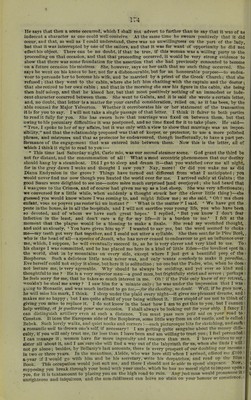
![BO far that some one wrote to the superieure to warn her, and that she must either give him up or explain to tlie superieure their relative position. She goes on :—“ Now, I must eitlier give you up or explain to tlie superieure our relative position. In the first place, I should become a Sister directly ; in tlie latter, I fear she will not keep me, and where on eartli to go to I do not know, until Alcide comes, and he will get such a version of the affair from Madame, that he will think I have been dread- fully imprudent; and yet, if we are ever to be all to each other, and fate keeps us apart, we must have some means of knoiving each other. I never could write to you again with any degree of confidence. I tremble at every word. However, I can trust you, come what may. Pray, write me directly, and tell what you think I had better do,—find out the author of the mischief, or treat the matter with the contempt it deserves; for when the person is base enough to open and read a letter, in my opinion they would be guilty of anything bad enough. I never could sufficiently express my contempt of such meanness. I cannot in the least remember wliat I wrote, but I suppose the usual amount of unre- flected nonsense. Pray excuse this. I am really wretched about it; a woman is so totally at tlie mercy of any wretch who chooses to be base enougli to calumniate her. Addio.” As I understand the sense of this letter, she alludes to the engagement which had taken place between them—that he had declared his love, liis honourable attachment to her, and proposed marriage, but tliat no definite time had been fixed for it. His answer to that letter is this :—“ Carissima Theresa mia,—Pm so sorry you are in a dilemma, if you dislike it, but I’ve been in one ever since I can recollect. If you can find out one of the male sex who has given you pain by any conjunction of our names. I’ll make a point of getting leave to go down and figlit him, as we are quite idle in tliat way here As I conceive it would be quite an impossibility to define our indefinable relative position, I see nothing you can do better than ask who wrote to the superioress and demand explanation from that individual; if anonymous, it can be safely treated with contempt. I do not promise to be a good guide as to the right and wrong, as so called in the parlance of a sctindalous soeiety ; but I will break a lance or argue with [part of tlie letter cut out here] any reasonable individual—upliolding against all comers or challengers that you (or I, as concerns you) have done no wrong.” He concludes by saying, “ So don’t trust me more tlian is the due, I hope, of a chivalrous savage. Addio—IVrite soon; write boldly all you think or feel. Penso a te.” Then, tiiere are other letters, but these, I believe, are all that it is necessary to refer to on this part of the case. These are, in fact, all the letters that passed between them at that period, with the excep- tion of one, in which she writes, “ In truth, I am not friends with you, Mr. Carlo, and you shall never sit on my divan again until you fulfil tlie promise better that you made there. I don't care so much about you now, for I have got anotlier!—a little Carlo with whom I am quite enchanted. It required all my diplomacy to get it—such an unlocking and locking up every night —such long happy chats until my lamp goes out 1 I hope that fellow standing up in top boots will not betray us.” The meaning of this, one would have thought, was that she had got a new lover, but the explanation she gave is, that it was a photographic likeness of the man she loved. This correspondence is only material as showing what was passing in the mind of Yelverton himself, that she considered him in the light of an honom’able accepted lover, though no time was fixed for then' marriage. It is for you to say whether those letters bear out the view of the case that has been presented on her behalf. The correspondence goes on in this way for some time, and I think it was in'the month of Ifebruary, 1S5G, that this lady went from Galata to the house of Madame Straubenzee, the previous interview having taken place in October, an interval of four months. The parties differ very much in their account of the relation.-.hip that existed between them during that visit at Madame Straubenzee’s. It appears that General Straubenzee commanded a brigade in the Crimea. He was a man whom Major Yelverton says it was his honour to be acquainted with. He had a wife—a woman, as far as we can judge from the evidence here, which, of course, is the only thing that we can take into consideration, for we are not at liberty to refer to our personal knowledge or recollection of that lady—but she was, at all events, a devoted rvife and an honourable woman. She was a woman who followed her husband,—her honourable and her loved husband,—through the dangers of that campaign; she was a woman, who, during a portion of that campaign, and at the very time, I believe, that this gentleman paid his first visit to Galata, was an inmate of tlie hospital, as appears from some of the letters; but it appears that her desire and her wish was, that if her husband should be in danger, his wife should be his nurse, and accordingly she followed him to the camp, and became the respected Inmate of her husband’s hut. It appears that Mrs. Straubenzee had formed an acquaintance ivith Miss Longworth. It appears, also, from some of the letters, that Mrs. Straubenzee was in some way or other—though not, perhaps to the full extent that Miss Longworth represented—aware of the acquaintance between her and Major Yelverton ; and there can be no doubt tliat she invited this young lady to visit her at her hut. Perhaps we might not be very far wrong in believing that Mrs. Straubenzee may have been in some degree iqfluenced in giving that invitation by a belief that an honourable attachment existed between the parties ; for I believe that if an honourable attachment exists between a young woman and a man who is looked upon as lier future husband, tliere is no objection or unwillingness displayed on the part of the young lady to go under honourable and safe protection into the neighbour- hood of tliat young man. Therefore I do not doubt that in her visit to the Crimea this young lady was influenced by the wish of meeting tliere tlie object of her love; and up to that time there can be no doubt that nothing had passed between tins couple that could have induced tlie lady to have looked on him in any liglit except tliat of an honourable admirer and an lionourable lover. That she loved him as women, honourable women, love the objects of their choice, I believe this correspondence shows. I believe, whatever cliange may liave come over this woman afterwards—it will be altogether for you to say whether there did or not—at this time slie was influenced by as pure](https://iiif.wellcomecollection.org/image/b28408214_0176.jp2/full/800%2C/0/default.jpg)