The Yelverton marriage case : Thelwall v. Yelverton : comprising an authentic and unabridged account of the most extraordinary trial of modern times, with all its revelations, incidents and details : specially reported.
- Avonmore, William Charles Yelverton, Viscount, 1824-1883.
- Date:
- 1861
Licence: Public Domain Mark
Credit: The Yelverton marriage case : Thelwall v. Yelverton : comprising an authentic and unabridged account of the most extraordinary trial of modern times, with all its revelations, incidents and details : specially reported. Source: Wellcome Collection.
Provider: This material has been provided by Royal College of Physicians, London. The original may be consulted at Royal College of Physicians, London.
178/198 page 174
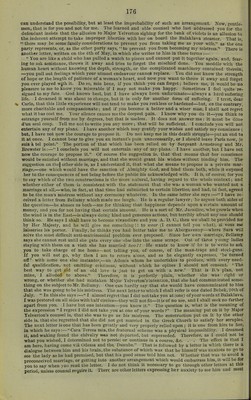
![He says that then a scene occurred, which T shall not advert to further than to say that it was of as indecent a character ns one could well conceive. At the same time he swears positively that it did occur, and that, as well as I could understand, there was no unwillingfness on the part of the lady, but that it was interrupted by one of the sailors, and that it was for want of opportunity he did not effect his object. There can be no doubt, if that be true, if this woman was a willing party to tlie proceeding on that occasion, and that that proceeding occurred, it would be very strong evidence to show that there was some foundation for the assertion that she had previously consented to become on a future occasion his mistress. She, however, says on her oath that no such thing occurred. She says he went on his knees to her, not for a dislionourable, but for an honourable purpose—to endea- vour to persuade her to become his wife, and be married by a priest of the Greek Church; that she refused ; that they went to the cabin, where she left him chatting with the captain and the doetor; that she retired to her own cabin j and that in the morning she saw his figure in the cabin, she being tlven half asleep, and that he kissed her, but tliat most positively nothing of an immodest or inde- cent character occurred between them. She went to Galata, and it is said she wrote a certain letter, and, no doubt, that letter is a matter for your careful consideration, relied on, as it has been, by tlie able counsel for Major Yelverton. Whether it corroborates his or her statement of the transaction it is for you to say. I will not take a single passage of that letter. I think it fairer to both parties to read it fUlly for yon. She has sworn here that marriage was fixed on between them, but that owing to ills pecuniary difficulties it was postponed, and no time fixed for it to take place. He said— True, I spoke to her of my affairs, but it was only with a view to show that marriage was an im]X)s- sibility,” and that the relationship proposed was tliat of keeper, or protector, to use a more polished phrase, and mistress^ and tliat as protector he endeavoured, tliough inefiectually, to have a part per- formance of the engagement that was entered into between them. Now this is the letter, all of which I think it right to read to you:— “ This time last Saturday night. Carlo mio, was our second steamer scene. God grant the third be not far distant, and the consummation of all! Wliat a most eccentric phenomenon that our destiny should hang by a steamboat. Did I go to sleep and dream it—that you watched over me all night, for in the grey dawn I woke and thought I saw you? Nay, more! Or did you wake me as did Diana Endymion in the grove ? Things have turned out different from what I anticipated; yon would never find me now though you hunted the world over for me. I arrived safely at Galata; the good Socurs were delighted to see me—notre mfere much surprised {and oveijoyed ; she had heard that 1 was gone to the Crimea, and of course had given me up as a lost sheep. She was very affectionate; we conversed for a little while, wlien suddenly a thought struck her (the clever little tiling)—she guessed you would know where I was coming to, and might follow me; so she said, ‘ Oh I ma chere enfant, vous ne pouvez pas resterici un instant !’ ‘ Wiat is the matter?’ I said. ‘ We have got the peste in the house, as in all the hospitals, and I will not sacrifice your young life, you who have been so devoted, and of whom we have such great hopes.’ I replied, ‘ But you know I don’t fear infection in the least, and don’t care a fig for my life—it is a burden to me.' I felt at the moment that the plague would be a blessing to make a finale. She read my wretched thought, and said anxiously, ' You have given him up ?’ I wanted to say yes, but the word seemed to choke ■ me—my teeth got very fast together, and I could not utter a syllable. She then sent for le Pere Bor6,. who is the head of all—a species of Jesuit, who has never ceased to endeavour to get an influence over • me, which, I suppose, he will eventually succeed in, as he is very clever and very kind to me. To i his charge I was committed, and he has placed me here in a kind of little Eden—tlie loveliest spot in i the world, shut in by mountains on every side, except where I just get a beautiful peep of the ■ Bosphorus. Such a delicious little nook never was, and only wants somebody to make it paradise.. Eve herself could not enjoy it alone, but here it is solitudino; no onebut the Padre, who, when he does = not lecture me, is very agreeable. Why should he always be scolding, and yet ever so kind and 1 thoughtful to me ? He is a very superior man—a good man, but frightfully strict and severe ; perhaps ■ he feels sorry for me, that he takes so much interest in me. Oh ! if the Pole only knew of my retreat,. wouldn’t he steal me away ? I saw him for a minute only; he was under the impression tliat I was ■ going to Monastir, and was much inclined to go too,—for the shooting, no doubt. Well, if he goes now,. he will miss his mark, I think. I sleep under the plaid every night—it gives me pleasant dreams, and I makes me so happy ; but I am quite afraid of your being without it. How stupid of me not to think of! giving you mine to replace it. I do not know in the least how I am to get tins to you, but I cannot: help writing, et je guettcrai pour une occasion. I shall always be looking out for your sliip. 1 fancy I' can distinguish artillery even at such a distance. You must pass mon petit nid on your road to Constan. It is on the European side of the Bosphorus, some little way from an old castle, and is called ■■ Bebek. Such lovely walks, and quiet nooks and corners !—such picturesque bits for sketching, and such' a romantic wcM to droivn one’s self, if necessary! I am getting quite sanguine about the money diffi-- culty, if you will only trust me, far less than I have been and am willing to trust you; I feel persuaded . I can manage it; women have far more ingenuity and resource than men. I have written to my Bister all about it, and I am sure she will find a way out of the labyrinth for us, when she finds I will not go alone; besides, by Bellamy’s last accounts, there is every prospect of our doubling our income ■ in two or three years. In the meantime, Alcide, who was here still when I arrived, oii'ered me ,£100 a-year if I would go with him and be his secretary, write his despatches, and read up the Blue Book. This occupation would just suit me, and there I should not be able to spend sixpence. Now, supposing you break through your bond with your uncle, which he has no moral right to impose upon j you, for Tt is tantamount to placing you on the high road to min. Any just man would prononnee it j, unrighteous and iniquitous, and the non-folfilment can leave no stain on your honour or con.“cionce. I](https://iiif.wellcomecollection.org/image/b28408214_0178.jp2/full/800%2C/0/default.jpg)