The Yelverton marriage case : Thelwall v. Yelverton : comprising an authentic and unabridged account of the most extraordinary trial of modern times, with all its revelations, incidents and details : specially reported.
- Avonmore, William Charles Yelverton, Viscount, 1824-1883.
- Date:
- 1861
Licence: Public Domain Mark
Credit: The Yelverton marriage case : Thelwall v. Yelverton : comprising an authentic and unabridged account of the most extraordinary trial of modern times, with all its revelations, incidents and details : specially reported. Source: Wellcome Collection.
Provider: This material has been provided by Royal College of Physicians, London. The original may be consulted at Royal College of Physicians, London.
194/198 page 190
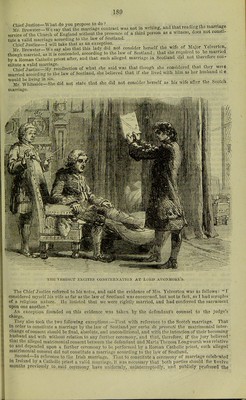
![Roman Catholic faith, and if there was no evidence of such profession of Catholicism by Major Yelverton, the ceremony performed by the Rev. ]\Ir. Mooney did not constitute a valid marriage. Mr. Whiteside said his lordship had told the jury that they were at liberty to take into consideration the letters which the defendant had written in Scotland, and the letters addressed to him there, in which he accepted the title of husband as evidence of the prior consent. He feared the jury were of opinion that they were not at liberty to take these letters into consideration, and he wished hig lordship to put this to them more distinctly. The Chief Justice said he would do so. The jury were called out, and the Chief Justice said that, with reference to the question of a marriage in Scotland, he wished them clearly to understand that he never intended to exclude from their consideration the evidence of subsequent recognition of that alleged marriage, such as was contained in the letters—the writing “ Mr. and Mrs. YelVerton” in the visitors’ book at Boon Castle, &c., so far as that class of evidence would, in their judgment, corroborate the evidence of the lady. Several jurors said they had understood that, and knew the letters referred to. Cliief Justice—But you are not to infer from this class of evidence any other marriage than the one alleged. The jury again retired. At twenty minutes past six o’clock they came into court. Their coming was awaited with intense excitement and great anxiety by a densely crowded court, and when they appeared, evidently bringing witli them a verdict, all became hushed into profound silence. The Chief Justice said—How say you, gentlemen. Was there a .Scotch marriage ? Foreman—Yes, my lord. Chief Justice—And was there an Irish marriage? Foreman—Yes, my lord. Chief Justice—Then yon find the defendant was a Roman Catholic for twelve months before ? Foreman—So we believe, my lord. Before the Foreman had spoken the last of his words, which gave the plaintiff an unqualified verdict, the universal joy and approval of all within hearing found expression in a most enthnsiastic burst of cheering, again and again renewed, accompanied by various other demonstrations of applause. Hats and handkerchiefs were waved, the members of the bar stood up and joined heartily in the public manifestations of delight; many of them actually took off their wigs and waved them with energy. Men of all ranks seemed to vie with one another in testifying their gratification at this triumph of morality and justice, and the vindication of the honour of their sex. Ladies seemed at a loss how to show their feelings; they waved handkerchiefs, then clapped their hands, then wept with joy, and looked a world of gratitude at the jurors whose proud privilege it was to right an innocent and injured woman. The fees fop the jurors having been handed up by the plaintilTa attorney, the Foreman handed them back to the Registrar, stating the jury did not wish to take any money in the case, but to give it for charity. In reply to the Registrar, they said they would wish the money to be given to the Sick and Indigent Room-keepers’ Society. This incident evoked another cheer Ibr the jury. The cheering in court for the verdict had been caught np by the mulritude wbo thronnad the hall and vphementlv reiterated bv them. One of the greaces rdemonstrations or popnxar enthusiasm thax pemapa ever was witnessed ia Dublin, took place as the Honourable Mrs. Yelverton proceeded from the Four Courts to the Gresham Hotel. It was one of those things that should be seen, as it is impossible to be described. Over fifty thousand people frantic with joy proceeded to bid her welcome as she issued from the hall. From an early hour in the evening thousands flocked in from every quarter of the city, and waited in feverish anxiety the result of the deliberations of the jury. From the highest to the lowest were seen in tliat crowd anxiously seeking information, and every person who came from the courts was warmly solicited to teU how “ the trial was going on.” As the evening advanced the rush became so great that it was found necessary to close the outer gates of the court-yards. Wlien it was known that the jury had retired to consider tlieir verdict, the crowds, which ex- tended along the entire of Inns-quay, and over the bridge in the direction of Winetavern-street, became feverish with excitement, and there was not one in tlie vast multitude that did not hope and, fear for the issue of the great trial, as if they had a personal and individual interest in it. Shortly after si.x o’clock, the cheering in the interior of the court was taken up outside, and when it was known that tlie Hon. Mrs. Yelverton had triumphed, one loud cliecr bur.st from every mouth, and was again and again repeated. Hats were thrown into the air, and every external demonstration of delight was evidenced by all present. Men shook hands with people tliey did not know, save by the fact that they looked as glad as themselves. Cars were to be seen rushing in every direction, bearing persons anxious to carry the news to distant parts of tlie city and to tlie telegraph offices, that the whole empire may bo made aware of the result of a trial which liad been read with sucli intense interest. It was when tlie gates were tliAwn open that the enthusiasm of tlie people rose to its height. One mass ofwaviu heads was to be seen in the distance, and in the vicinity of the gates. Crowd crushed after crowd to obtain a look at the great woman who had foiiglit so nobly for her honour and her sex, and wlio liad won tlie fl<dit. The people insisted tliat tliey should draw her in triumpli to lier hotel. Many sought to liave the lionour of saying tliat they assisted in drawing home tlie Hon. Mrs. Yelverton after she had gained tlie victory, but tliey were crushed off by tlie masses of people who wore pushing tlieirway to](https://iiif.wellcomecollection.org/image/b28408214_0194.jp2/full/800%2C/0/default.jpg)