The Yelverton marriage case : Thelwall v. Yelverton : comprising an authentic and unabridged account of the most extraordinary trial of modern times, with all its revelations, incidents and details : specially reported.
- Avonmore, William Charles Yelverton, Viscount, 1824-1883.
- Date:
- 1861
Licence: Public Domain Mark
Credit: The Yelverton marriage case : Thelwall v. Yelverton : comprising an authentic and unabridged account of the most extraordinary trial of modern times, with all its revelations, incidents and details : specially reported. Source: Wellcome Collection.
Provider: This material has been provided by Royal College of Physicians, London. The original may be consulted at Royal College of Physicians, London.
91/198 page 87
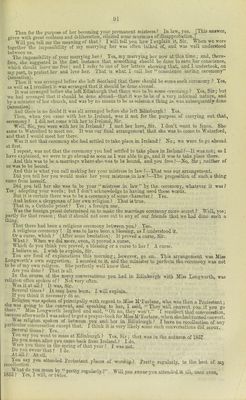
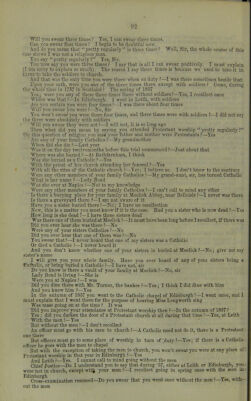
![Was any one there to see you going in ? I don’t recollect. For whom was the berth taken in the steamer ? hor Miss Longwortli. And you were seen going into her cabin? Ivo, I did not say that. Did you not state you wcrd shown in ? No, I was shown into the main cabin. There were no passengers when wo came in, onl}' the people belonging to the ship, ^•ith us to the steamer. _ She had been put into the convent before that. seeing us going into the inner cabin. _ . i. ^ ir Were vou very anxious to get possession of her in Jidmburgh ? les. Had this idea’been dwelling in your mind ? I was very anxious. Did you ever speak to her of how people were married in Scotland ? Miss M'Farlane did not come I don’t recollect anv one No. On any occasion ? I recollect on one- occasion speaking of what I had seen at a railway station in comiim- up to London—I mean a notice—to the effec.t that border marriages were done away with ■ and I had a recollection then of an act of parliament which had passed in the session before, and my belief was—and I recollect a conversation in which I told that belief to Miss Longworth— that these marriages were not done away with, and that Scotland and England were more assimi- lated with regard to marriages. . , x You had this conversation with her about Scotch marriages? Yes, naming that tact. Where did that conversation take place ? In Mr. Gamble’s house. In the little room? Yes. , Was there ever a prayer-book there ? Yes, Miss M'Farlane’s prayer-book; I have a recollection of Jiliss M'Farlane haying a prayer book there. Did you ever open it ? No. How did you know what it was ? By the outside. Did you ever take it into your hand ? Never, to the best of my recollection. Will you swear you dj.d not? I cannot swear it; I may have moved it from one table to another; I did not take it with an intention into my hand. I don’t want your intentions. On your oath. Sir, did you take that prayer hook into your hand ? On my oath, I have no recollection of taking it. I don’t want your recollection. Did you take it ? You can’t make me recollect it. Yes, Sir, because you don’t wish to do so ? I do wish to tell you the whole truth, and I am sure I have not spared myself. I ask you again, did you take it in your hand ? I have no recollection. Did you open it ? I did not. Will you swear positively you did not ? I can’t say I did not take it up. It is possible I might have moved it from one table to another. What was on the back of it ? I have no recollection. Did you not say you knew it by reading what was on the back ? I did not say by reading it; I said I knew it by the outside. It was a stout little book of the usual shape. Whose was the book ? I suppose it was Miss M'Farlane’s. I imagined it to have been hers of course, because it was there. I had every reason to believe it was Miss M'Farlane’s. How long wass Miss Longworth in Edinburgh before this occurrence in March which you have described ? Six or seven weeks. You were anxious to have possession of her person ? Yes. Your mind was on it ? Yes. Had you the idea constantly before you ? Yes. AVould you have stopped at anything to realize it ? [The witness did not answer.] answer my question—would you ? I would not have committed a rape to do it.- But anything short of a rape you would have resorted to, to realize yourdesigii? would not have taken possession of her person without her consent. But would you have used any means to get that consent—anythipg short of rape ? What sort of means do you mean ? Anything whatever—arguments, persuasions, endearments ? Endearments, yes. Ar^ments ? No. This idea was haunting you constantly day and night for seven weeks ? No. I was away part of the time. But did it follow you where you wont ? Yes. How large was this room of Mrs. Gamble’s ? It was a small room, about 14 or 15 feet wide, oi; thereabouts, and I should think 20 feet or so the other way. Did the bedroom open into it ? It did. Did you know that Miss M'Farlane sat in the bedroom ? She did sometimes. When you were in the other room ? Yes. You said that about the 15th of April she left in the steamer for Hull. Whore did she go to from that ? To Abergavenny, in Wales. Did you write to her that when she was a week in Abergavenny j-ou would like her to write to you. Did you not say in one of your letters “ I shall bo anxious to hear from you when you have been about a week at Abcrg y ? That is my letter. Had you, before she left Edinburgh, spoke of a inatTiago at all besides (ho conversation you nave said about Border marriages ? No, unless I spoke the same thing over again. But you might have spoken about that several times ? I only recollect one conversation. I cannot be positive about it. Come, Sir, No, Sir. I](https://iiif.wellcomecollection.org/image/b28408214_0091.jp2/full/800%2C/0/default.jpg)
 No text description is available for this image
 No text description is available for this image
 No text description is available for this image