Postencephalitic respiratory disorders : review of syndromy, case reports, physiopathology, psychopathology and therapy / by Smith Ely Jelliffe.
- Smith Ely Jelliffe
- Date:
- 1927
Licence: In copyright
Credit: Postencephalitic respiratory disorders : review of syndromy, case reports, physiopathology, psychopathology and therapy / by Smith Ely Jelliffe. Source: Wellcome Collection.
71/152 (page 59)
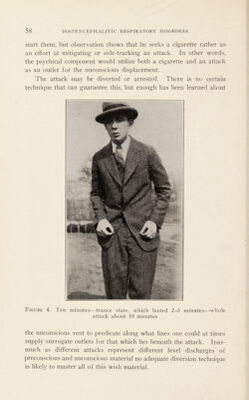
![Eating as with case II is accompanied by increase rather than by decrease of the respiratory difficulty. A mild attack (high level) discharge will be finished in four to five minutes, the breathing will not be over thirty to forty to the minute, and there will be no trance state following. In a severer attack the puffing becomes deeper and more rapid, the patient becomes definitely anxious, the contortions of the nose, wide dilatation of the nares, protrusion of the lips, etc., increasing fixation of the body, fixed rigid mouth movements, puffing or blowing takes place, the respirations go up to seventy to the minute, the pulse to 100, the hands begin to become cyanotic, and the patient is “ feel¬ ing rotten,” as he may be able to tell you—then the breathing gets more superficial and a definite cessation of breathing occurs (see tracing). The parkinsonian rigidity becomes more pronounced; he used to shiver a great deal at this stage, and he has a definite hypo¬ thermia—96° F.—more marked on the left than the right side; the eyes look off, the pupils dilate somewhat, the face becomes mask-like; the palpebral fissure narrows, the mouth purses up, saliva com¬ mences to drivel from the mouth, and in from ten to twenty minutes after three, four, and five minutes of this trance—in which he states his mind is a blank—in which he only “ wonders if he will ever get well ”—he comes to, smiles, says he has “ snapped out of it ” and is all right again. When he was on the farm and being “ treated ” by his nurse, he was frequently obscene and almost violent in these trance and semitrance states, which at times would persist half an hour [hence the “ degeneracy ” designated by B.]. More than half of his attacks are “ trance ” free—and there is a record in earlier attacks of a partial loss of consciousness and the necessity for lying down in certain of these trance states. He has never fallen in one of them, but almost “ goes out,” he says. [These are probably the petit mal attacks to which Dr. Burr refers as diagnosed by other physicians. Narcolepsy attacks of others.] “ Trance ” attacks have been recorded without any recognizable antecedent breathing attacks. These were more common during his stay at camp and while on the farm—especially at times when he had a loathing for his male nurse. In the earlier periods the breathing attacks were accompanied by tetany-like stiffness in his jaw, his hands, left>right, and occasionally painful cramps in the feet. One severe attack lasting thirty-five minutes took place during an](https://iiif.wellcomecollection.org/image/b2981246x_0071.jp2/full/800%2C/0/default.jpg)