Postencephalitic respiratory disorders : review of syndromy, case reports, physiopathology, psychopathology and therapy / by Smith Ely Jelliffe.
- Smith Ely Jelliffe
- Date:
- 1927
Licence: In copyright
Credit: Postencephalitic respiratory disorders : review of syndromy, case reports, physiopathology, psychopathology and therapy / by Smith Ely Jelliffe. Source: Wellcome Collection.
91/152 (page 79)
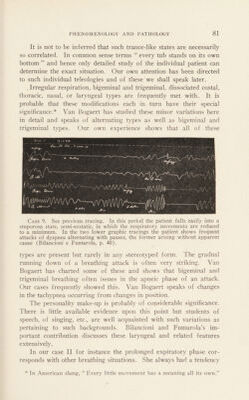
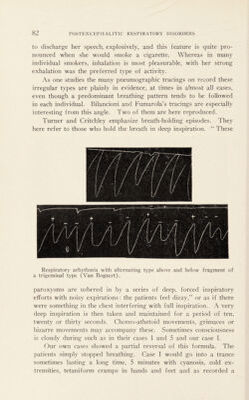
![specifically upon the chemical problems involved cannot be entered into here even though we are inclined to feel that far reaching situa¬ tions are involved.* Adlersberg and Porges have offered an intro¬ ductory chapter into this and it must be left here. Our case II offered an exquisite example of what has been described as a persistent tachypnea—yet here it was evident that periodicity was present. Our reading of the many cases tends to make us believe there is no really permanent tachypnea. Even in the cases cited by Levy and in her pneumographic traces there is evidence of a certain periodicity. There is a rise and fall, and attacks can be separated even though the interval seems slight at times. Suckow’s tracings show some very striking alternate apneic and tachypneic attacks. In our case II which is one of the most severe we have seen there would be 5-, 10-, 15-minute intervals between attacks—appar- Abb. 2. (a) Seufzer. Sighing, yawning respiratory curve (Suckow). ently related to diversion or other incidents. Here chiefly the attack would terminate with one or more deep yawns—which were accom¬ panied by a feeling of deep satisfaction. Failing such satisfaction the breathing would go on. With a satisfactory deep yawn after several smaller ones—the patient would either enter an apneic phase with increasing cyanosis or be free for a while—(the psychoanalytic correlation with an orgasm [sialorrheal or leucorrheal discharge] was quite evident in this case and will be discussed later). Levy groups these sighing, yawning episodes with the tachypneas : Turner and Critchley speak of them as belonging in their second group. To us they belong with the whole unconscious mechanism and are of special significance when one views the whole situation teleo¬ logically. As no one but ourselves, Witzel and Runge have dealt with this phase of the pathopsychophysiological situation we reserve * See Kraus, F. Klinische Sysgvoligie. Der Fiefen Person. Berlin, 1926.](https://iiif.wellcomecollection.org/image/b2981246x_0091.jp2/full/800%2C/0/default.jpg)