Milk, its nature and composition : a handbook on the chemistry and bacteriology of milk, butter and cheese / by C. M. Aikman.
- Date:
- 1895
Licence: Public Domain Mark
Credit: Milk, its nature and composition : a handbook on the chemistry and bacteriology of milk, butter and cheese / by C. M. Aikman. Source: Wellcome Collection.
Provider: This material has been provided by the Royal College of Physicians of Edinburgh. The original may be consulted at the Royal College of Physicians of Edinburgh.
107/208
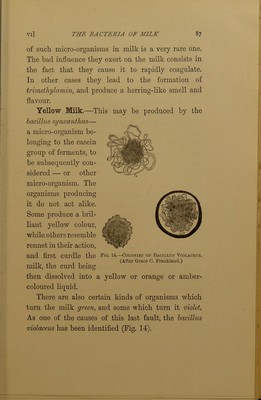
![j vi] THE BACTERIA OF MILK 87 of such micro-organisms in milk is a very rare one. The bad influence they exert on the milk consists in the fact that they cause it to rapidly coagulate. In other cases they lead to the formation of trimethylamin, and produce a herring-like smell and flavour. Yellow Milk.—This may be produced by the bacillus synxanthus— a micro-organism be- longing to the casein group of ferments, to be subsequently con- sidered — or other micro-organism. The organisms producing it do not act alike. Some produce a bril- liant yellow colour, while others resemble rennet in their action, and first curdle the Fia-—colonies of bacillus violacecs. (After Grace C. Frankland.) milk, the curd being then dissolved into a yellow or orange or amber- coloured liquid. There are also certain kinds of organisms which turn the milk green, and some which turn it violet. As one of the causes of this last fault, the bacillus violaceus has been identified (Fig. 14).](https://iiif.wellcomecollection.org/image/b21938866_0107.jp2/full/800%2C/0/default.jpg)
 No text description is available for this image
 No text description is available for this image
 No text description is available for this image