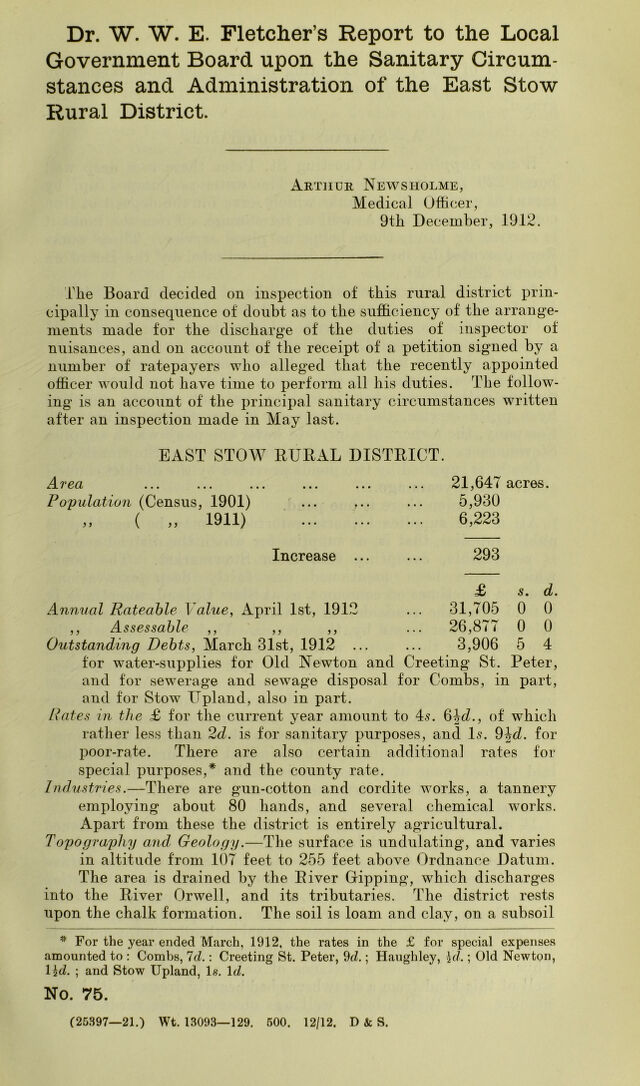
Dr. W.W.E. Fletcher's report to the Local Government Board upon the sanitary circumstances and administration of the East Stow Rural District.
- Fletcher, Wilfred W. E.
- Date:
- 1912
Licence: In copyright
Credit: Dr. W.W.E. Fletcher's report to the Local Government Board upon the sanitary circumstances and administration of the East Stow Rural District. Source: Wellcome Collection.
4/16 page 2
![composed of heavy clay excepting at Hangliley aud Wetherden and tlie ur])aii ]iart of Stow Upland, wliere t]ie snhsoil is cliiefly gravel. A.—Sanitary Circumstances. Water Supplies.—At Greeting St. Peter there is a deep well bored 220 feet into the chalk. The water is pumped up, by means of a windmill, to tanks which serve for the deposit of iron contained in the water as well as for storage. From the tanks it is carried by hand, there being no piped service. Tliese works were provided by means of a loan, sanctioned by the Board on October 28th, 1899. At liaughley there is a public well bored to a depth of 184 feet. It is furnished with a hand-pump, but there is no piped service. Old Newton is provided with supplies from four ponds, and from a deep well bored 278 feet into the chalk. Stow Upland in its rural part derives water from eight ponds; but the urban portion of the parish, which is practically con- tinuous with Stowmarket, is mainly, but not entirely, supplied by a piped service, the property of Messrs. Greene, King, and Company, the owners of a private water company which supplies Stowmarket. The water is derived from a well at Stowmarket. Combs is supplied by two ponds provided by the district council about fifteen years ago. At Wetherden there is one pond. All of the supplies hitherto referred to may be regarded as public supplies, that is, as supplies for which the district council is responsible, excepting that from Stowmarket. The ponds which have been mentioned are fairly deep excavations, situated sometimes on commons, as at Stow Upland, sometimes in a field near the roadside, as at Combs. They are all on sites belonging to, or leased by, the council. Under the advice of the late inspector they were, with possibly one or two exceptions, enclosed by corrugated iron fences with a gateway and steps leading down to the water, but pumps are provided in some instances by which the water can be drawn at some distance from the ponds, e.g., at Stow Upland. The ponds are not covered in. The water in them may to some extent be furnished by springs, but it is essentially subsoil water—indeed land drains have been laid to feed some of them—and is liable to subsoil pollution as well as to risk from dirtv vessels used for drawing' water bv careless people. It must not be supposed, however, that the above mentioned places are fully served by tlie supplies referred to, for private wells, private ponds, &c., are also in use. Some of these sources are not free from suspicion, being in situations wliere pollution is more than probable. Tims, in the urban portion of Stow Upland some twenty or more houses are dependent upon local surface wells siink in a porous gravel subsoil, and usually in back yards and gardens where objectionable pollution may occur. Thus, in one instance a distance of only a few feet separates a well of this kind from a strawberry bed heavily dressed with horse- niiinure. At Wetherden a well was observed four yards from a](https://iiif.wellcomecollection.org/image/b28143188_0006.jp2/full/800%2C/0/default.jpg)