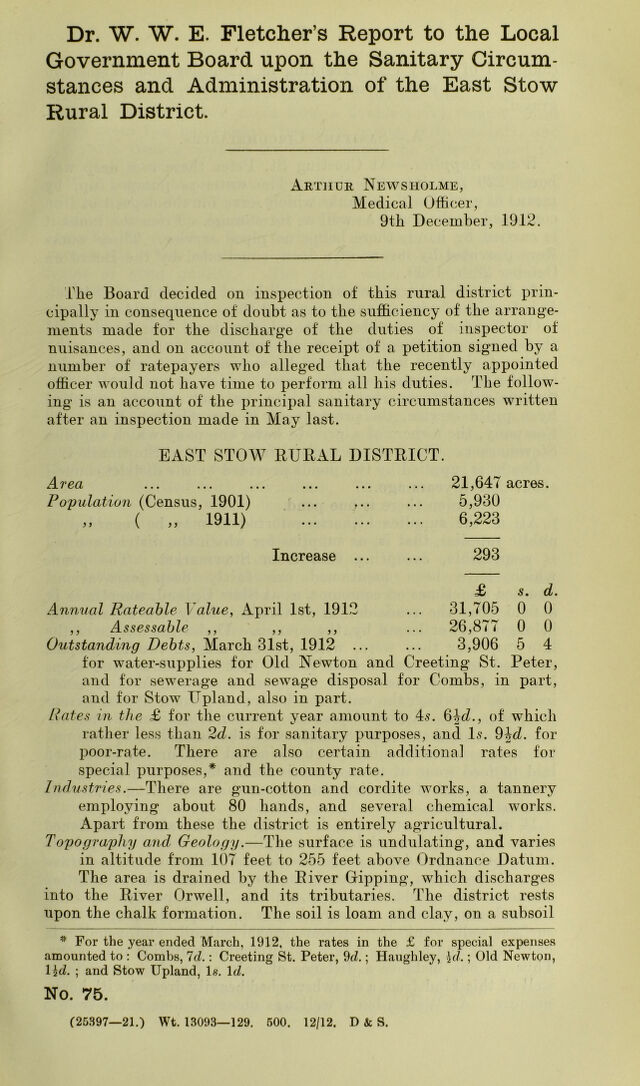
Dr. W.W.E. Fletcher's report to the Local Government Board upon the sanitary circumstances and administration of the East Stow Rural District.
- Fletcher, Wilfred W. E.
- Date:
- 1912
Licence: In copyright
Credit: Dr. W.W.E. Fletcher's report to the Local Government Board upon the sanitary circumstances and administration of the East Stow Rural District. Source: Wellcome Collection.
5/16 page 3
![privy cesspit, aud eiglit yards from the churchyard, which is t)ii a higher level. At Haiigdiley there is a private well, said to he only 12 feet deep, two yards from a double privy cesspit, three yards from two pail-closets (formerly privies with cesspit), and ten yards from a cesspool for house slops; the water is used tor drinking purposes. AVith respect to places in the district which have not been dealt with above, and which are without any supplies provided by the district council, the inhabitants are dependent upon open ponds— some by the roadside, some in fields, and some in gardens—and upon wells. Few of these sources appear to be likely to supply water of good quality. The pond water is merely subsoil drainage, and the same may be said of that in most of the shallow surface wells, which are dry-steined. One of these wells, at Iluxhall, is fed by a pipe bringing water from a pond in an adjacent orchard; another well, at Shetland Common, intended for the supply of a new dwelling, has been sunk two or three jards from a pond with the idea of collecting water infiltrating through the intermediate subsoil. This water has been con- demned. Near this spot is a row of dwellings supplied by a well dug to a great depth and lined by brickwork, which has been well constructed, but has been laid without cement or even mortar, so that percolation of surface and subsoil water may take place. This well is fitted with a windlass. There may be other deep wells in the district which draw water from a considerable depth, but little information could be obtained on this point. Some of the ponds observed were greatly in need of cleansing from deposits, and of freeing from vegetation. Much of the water in the district contains a considerable amount of iron, and some of it possesses such a strong odour, connected with the presence of sulphide of iron, that people retrain from its use. The water supplied by Messrs. Greene, King, and Co. is of a yellowish colour, and is very hard. Apart from the doubtful quality of much of the water used in this district for domestic purposes, the question of sufficiency is one of serious import; at times there is great scarcity in many places. A petition was received by the Board in January last from certain inhabitants who alleged that the district council had made default in failing to supply water for the parishes of Haughley, Combs, and the non-urban part of Stow Upland. The council is now in correspondence with a firm of water- engineers with a view to obtaining expert advice as to the pro- vision of a water-supply in Combs; and, at the time of my visit, a recommendation was about to be laid before the council at the next meeting by the housing committee for Stow Upland to engage tlie same firm to advise the conncil as to that parish also. TTie surveyor, also, was about to report to the council as to the water-supply of Haughley. Steps should also be taken for the provision of a satisfactory water supply in other parishes. Seiveraijp and Sewarje Disposal.—^Phe urban portion of Stow Upland which adjoins StoAvmarket, and that ]nart of Combs which is known as Combs Ford, are sewered to two collect- ing tanks from which the sewage is pumped, by means of](https://iiif.wellcomecollection.org/image/b28143188_0007.jp2/full/800%2C/0/default.jpg)