Manual of therapeutics / by L. Martinet ; translated with alterations and additions, Robert Norton.
- Louis Martinet
- Date:
- 1830
Licence: Public Domain Mark
Credit: Manual of therapeutics / by L. Martinet ; translated with alterations and additions, Robert Norton. Source: Wellcome Collection.
Provider: This material has been provided by the National Library of Medicine (U.S.), through the Medical Heritage Library. The original may be consulted at the National Library of Medicine (U.S.)
22/288
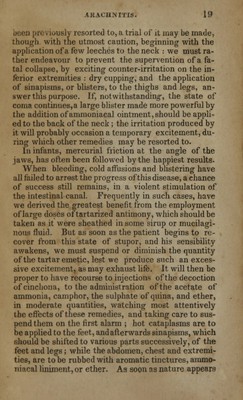
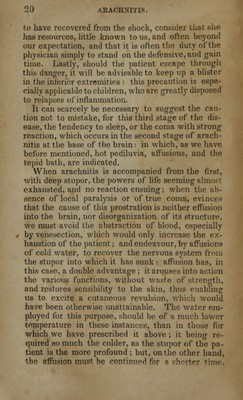
![blood ; which is, moreover, not altogether free ft danger.] To oppose the return of cerebral congestion, it is proper to cover the head with thin linen cloths, re- peatedly wetted with cold water, the temperature of which should be made gradually lower, to prevent subsequent re-action. Pulmonary catarrh, which is sometimes the consequence of these cold applica- tions, must be guarded against, by covering the chest with flannel. We can exercise a powerful control over the ge- neral reaction, (that is, frequency of pulse with heat of skin,) as well as over the cerebral disturbance, and the convulsions which so frequently occur in children, by directing a continued stream of cold water upon the head, and if the organs ofthe chest are in a healthy state, over the whole body; otherwise the patient, must be previously placed in a warm bath, up to the neck. These affusions should be repeated as often as the cerebral excitement, heat of skin, and frequency of pulse,return; they must,however,be discontinued,if the body does not readily recover its natural tempera- ture, and especially if it remains cold ; also, if the pa- tient grows weaker and his pulse becomes smaller and more frequent. On the contrary, when the general heat, developement of pulse, and signs of cerebral congestion increase, it becomes necessary, though with much caution, to renew the application of leeches to the base ofthe 6kull. If the period of reaction and excitement has nearly passed away, and the antiphlogistic treatment has not succeeded in overcoming the disease, but, on the contrary, the body in various parts is losing its sen- sibility, and debility and stupor become extreme, with almost total loss of intellect, and a small feeble pulse, we must no longer expect assistance from the ab- straction of blood ; if. however, this measure has not](https://iiif.wellcomecollection.org/image/b21139350_0022.jp2/full/800%2C/0/default.jpg)
 No text description is available for this image
 No text description is available for this image
 No text description is available for this image