Licence: In copyright
Credit: A companion to Latin studies. Source: Wellcome Collection.
Provider: This material has been provided by Royal College of Physicians, London. The original may be consulted at Royal College of Physicians, London.
861/940 page 817
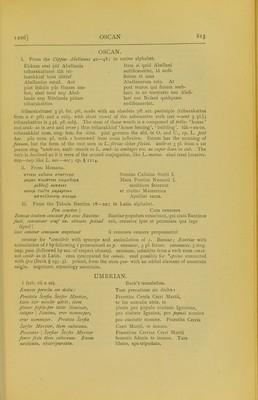
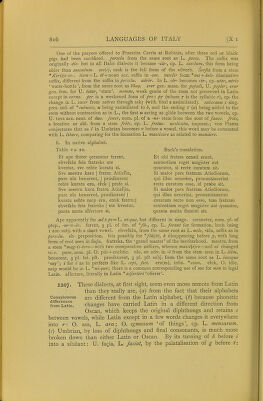
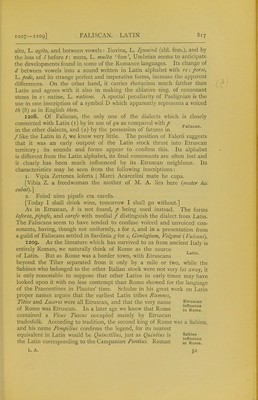
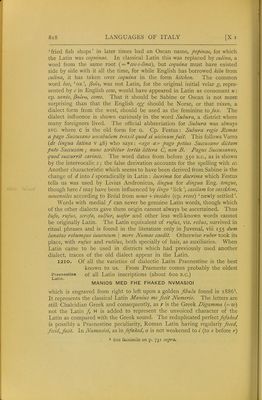
![aitu, L. agiio, and between vowels: liuvina, L. Jguuind (abl. fern.), and by the loss of / before /: miita, L. multa ' fineUmbrian seems to anticipate the developments found in some of the Romance languages. Its change of d between vowels into a sound written in Latin alphabet with rs: perse, L. pede, and its strange perfect and imperative forms, increase the apparent difl'erences. On the other hand, it carries rhotacism much farther than Latin and agrees with it also in making the ablative sing, of consonant stems in e: natine, L. natione. A special peculiarity of Paelignian is the use in one inscription of a symbol D which apparently represents a voiced th (G) as in English then. 1208. Of Faliscan, the only one of the dialects which is closely connected with Latin (i) by its use of qu as compared withp paiiscan in the other dialects, and (2) by the possession of futures in /like the Latin in b, we know very little. The position of Falerii suggests that it was an early outpost of the Latin stock thrust into Etruscan territory; its sounds and forms appear to confirm this. Its alphabet is different from the Latin alphabet, its final consonants are often lost and it clearly has been much influenced by its Etruscan neighbour. Its characteristics may be seen from the following inscriptions: 1. Vipia Zertenea loferta | Marci Acarcelini mate he cupa. [Vibia Z. a freedwoman the mother of M. A. lies here {inater hie cubat)?\ 2. Foied uino pipafo era carefo. [Today I shall drink wine, tomorrow I shall go without.] As in Etruscan, b is not found, p being used instead. The forms loferta, pipafo, and carefo with medial / distinguish the dialect from Latin. The Faliscans seem to have tended to confuse voiced and unvoiced con- sonants, having, though not uniformly, z for s, and in a presentation from a guild of Faliscans settled in Sardinia g for c, Gonlegium, Volgaiii (Vulcani). l2og. As the literature which has survived to us from ancient Italy is entirely Roman, we naturally think of Rome as the source of Latin. But as Rome was a border town, with Etruscans ^ beyond the Tiber separated from it only by a mile or two, while the Sabines who belonged to the other Italian stock were not very far away, it is only reasonable to suppose that other Latins in early times may have looked upon it with no less contempt than Rome showed for the language of the Praenestines in Plautus' time. Schulze in his great work on Latin proper names argues that the earliest Latin tribes Ramnes, Titles and Luceres were all Etruscan, and that the very name Etruscan of Rome was Etruscan. In a later age we know that Rome in Rome, contained a Vicus Tuscits occupied mainly by Etruscan tradesfolk. According to tradition, the second king of Rome was a Sabine, and his name Pompillus confirms the legend, for its nearest equivalent in Latin would be Qulnctlllus, just as Quuiiius is Sabine the Latin corresponding to the Campanian Pontius. Roman in Rome. L. A. 52](https://iiif.wellcomecollection.org/image/b24750694_0861.jp2/full/800%2C/0/default.jpg)
 No text description is available for this image
 No text description is available for this image
 No text description is available for this image