Licence: In copyright
Credit: A companion to Latin studies. Source: Wellcome Collection.
Provider: This material has been provided by Royal College of Physicians, London. The original may be consulted at Royal College of Physicians, London.
872/940 (page 828)
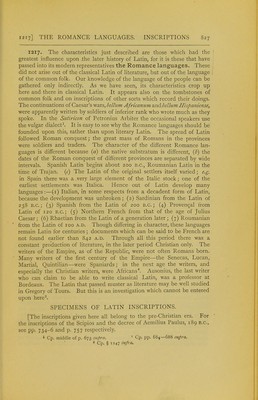
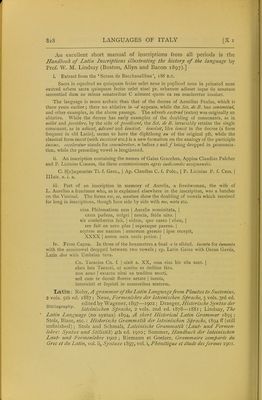
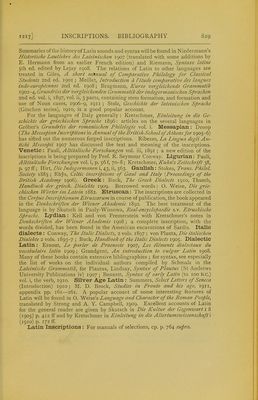
![An excellent short manual of inscriptions from all periods is the Handbook of Latin Inscripimts illustrating the history of the language by Prof. W. M. Lindsay (Boston, AUyn and Bacon 1897).] i. Extract from the 'Sctum de Bacclianalibus ', 186 B.C. Sacra ia oquoltod ne quisquam fecise uelet neue in poplicod neue in j)riuatod neue exstrad urbem sacra quisquam fecise uelet nisei pr. urbanum adieset isque de senatuos sententiad dum ne minus senatoribus C adesent quom ea res cosoleretur iousiset. The language is more archaic than that of the decree of Aemilius Paulus, which is three years earlier; there no ablative in -d appears, while the Set. de B. has sententiad, and other examples, in the above passage. The adverb exstrad (extra) was originally an ablative. While the decree has early examples of the doubling of consonants, as in uelkt and possidere, by the side of posedisent, the Set. de B. invariably retains the single consonant, as in adieset, adesent and iousiset. iousiset, like iousit in the decree (a form frequent in old Latin), seems to have the diphthong ou of the original pft, while the classical form iussit (with iussisset etc.) is a new formation on the analogy of the participle iusstis. cosoleretur stands for consuleretnr, n before s and f being dropped in pronuncia- tion, while the preceding vowel is lengthened. ii. An inscription containing the names of Gains Gracchus, Appius Claudius Pulcher and P. Licinius Crassus, the three commissioners agris iudicandis assignaftdis. C. S[e]mpronius Ti. f. Grac, | Ap. Claudius C. f. Pole, | P. Licinius P. f. Cras. | Illuir. a. i. a. iii. Part of an inscription in memory of Aurelia, a freedwoman, the wife of L. Aurelius a freedman who, as is explained elsewhere in the inscription, was a butcher on the Viminal. The forms ree, ee, naatavt show the doubling of vowels which survived for long in inscriptions, though here side by side with me, nata etc. uiua Philematium sum | Aurelia nominitata, | casta pudens, uolgei | nescia, feida uiro. | uir conleibertus fuit, | eidem, quo careo | eheu, | ree fuit ee uero plus | superaque parens. | septeni me naatam | annorum gremio | ipse recepit, XXXX I annos nata necis potior. | iv. From Capua. In three of the hexameters a final -s is elided, iuenta for iuuenta with the semivowel dropped between two vowels; cp. Latin Gaius with Oscan Gaviis, Latin duo with Umbrian tuva. Cn. Taracius Cn. f. | uixit a. XX, ossa eius hie sita sunt. | eheu heu Taracei, ut acerbo es deditus fato. non aeuo | exsacto uitai ea traditus morti, sed cum te decuit fiorere aetata | iuenta, interieisti et liquisti in maeroribus matrem. Latin: Roby, A grammar of the Latin Language from Plautus to Suetonius, 2 vols. 5th ed. 1887 ; Neue, Formcnlehre der lateinischen Sprache, 3 vols. 3rd ed. Bibiioo-ra h edited by Wagener, 1897—1902; T)rdLZg&r,f{istorische Syntax der 1 lograp y. lateiiiischen Sprache^ 2 vols. 2nd ed. 1878—1881; Lindsay, The Latin La?iguage (no syntax) 1894, A short Historical Latin Grammar 1895 ; Stolz, Blase, etc.: Historische Gra7nmatik der lateinischen Sprache, 1894 ff (still unfinished); Stolz and Schmalz, Lateinische Grammatik {Laut- und Formen- lehre: Syntax tmd Stilistik) ^ih. 1910; Sommer, Handbuch der lateinischen Laut- mid Fo7-menlehre 1902 ; Riemann et Goelzer, Grammaire comparde du Grec et du Latin, vol. ii, Syntaxe 1S97, vol. i, Phont'tique et etude des formes 1901.](https://iiif.wellcomecollection.org/image/b24750694_0872.jp2/full/800%2C/0/default.jpg)