Licence: In copyright
Credit: A companion to Latin studies. Source: Wellcome Collection.
Provider: This material has been provided by Royal College of Physicians, London. The original may be consulted at Royal College of Physicians, London.
886/940 (page 842)
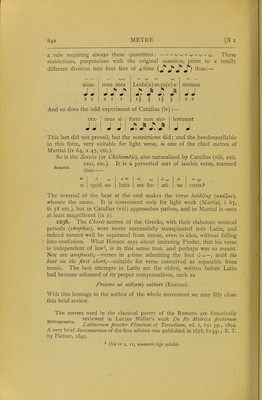
![a rule requiring always these quantities: w^-v^-v^-^. These restrictions, purposeless with the original scansion, point to a totally different division into four feet of 4-time {J^^J^^) thus:— uiua- JJ 2 2 — WW mus mea J h i^ 211 Lesbi(a) atqu(e) a- h P» 4 i 4 i memus 2 2 And so does the odd experiment of Catullus (Iv):— lestumst ora- I I mus SI forte non mo- h s ^ R This last did not prevail, but the restrictions did; and the hendecasyllable in this form, very suitable for light verse, is one of the chief metres of Martial (iv 64, x 47, etc.). So is the Scazon (or Chdliambic)^ also naturalised by Catullus (viii, xxii, xxxi, etc.). It is a perverted sort of iambic verse, scanned thus:— Scazon. — \J — \j — sy 0 quid so- lutis est be- ati- us — C7 curis ? The reversal of the beat at the end makes the verse hobbling (o-xa^tov), whence the name. It is convenient only for light work (Martial, i 67, iii 58 etc.), but in Catullus (viii) approaches pathos, and in Martial is once at least magnificent (ix 2). 1236. The Choric metres of the Greeks, with their elaborate musical periods {strophae), were never successfully transplanted into Latin, and indeed cannot well be separated from music, even in idea, without falling ' into confusion. What Horace says about imitating Pindar, that his verse is independent of law^, is in this sense true, and perhaps was so meant, Nor are anapaests,—verses in 4-time admitting the foot ww-, with t]ie beat on the first short,—suitable for verse conceived as separable from music. The best attempts in Latin are the oldest, written before Latin had become ashamed of its proper compensations, such as Priamo ui uit{am) euitari (Ennius). With this homage to the author of the whole movement we may fitly close this brief review. The metres used in the classical poetry of the Romans are historically ,. . reviewed in Lucian Miiller's work De Re Metrica io'etarum Bibliography. _ ■* Latinonim praeter Plautuin et Tercntium, ed. 2, 651 pp., 1894. A very brief Summarium of the first edition was published in 1S78, 82 pp.; E. T. by Platner, 1892. * Odt\s 1, II, numeris lege solutis.](https://iiif.wellcomecollection.org/image/b24750694_0886.jp2/full/800%2C/0/default.jpg)