The water cure in chronic disease : an exposition of the causes, progress and terminations of various chronic diseases of the digestive organs, lungs, nerves, limbs and skin : and of their treatment by water, and other hygienic means / by James Manby Gully.
- James Manby Gully
- Date:
- 1856
Licence: Public Domain Mark
Credit: The water cure in chronic disease : an exposition of the causes, progress and terminations of various chronic diseases of the digestive organs, lungs, nerves, limbs and skin : and of their treatment by water, and other hygienic means / by James Manby Gully. Source: Wellcome Collection.
Provider: This material has been provided by The University of Glasgow Library. The original may be consulted at The University of Glasgow Library.
24/478 (page 6)
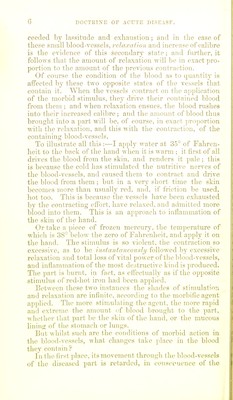
![ceeded by lassitude and exliaustiou; liiid in Iho case of these small blood-vessels, relaxation and increase of calibre is the evidence of this secondary state; and further, it follows that the amount of relaxation will be in exact pro- portion to the amount of the previous conti'action. Of course the condition of the blood as to quantity is affected by these two opposite states of the vessels that contain it. When the vessels contract on the application of the morbid stimulus, they drive their contained blood from them ; and when relaxation ensues, the blood rushes into their increased calibre ; and the amount of blood thus broup;ht into a part will be, of course, in exact ]n'oportion with the relaxation, and this with the contraction, of the containing blood-vessels. To illustrate all this:—I apply water at 35° of Fahren- heit to the back of the hand when it is warm ; it first of all drives the blood from the skin, and renders it pale ; this is because the cold has stimulated tlie nutritive nerves of the blood-vessels, and caused them to cont)'act and drive the blood I'rora them; but in a very short time the skin becomes more than usually red, and, if friction be used, hot too. This is because the vessels have been exhausted by the conti'actiug effort, have relaxed, and admitted more blood into them. This is an approach to inflammation of the skin of the hand. Or take a piece of frozen mercury, the temperature of whicli is 38° lielow the zero of FahrenluMt, and apply it on the hand. The stimulus is so violent. Ihe contraction so excessive, as to be iii.s/antancoiishj followed by excessive relaxation and total loss of vital power of the blood-vessels, and inflammation of the most dcAtructive kind is produced. The part is burnt, in fact, as eflcctually as if the opposite stimulus of red-hot iron had been applied. ]5etwecu these two instances the shades of stimulation and relaxation are infinite, according to the morbific agent ap])]icd. 'I'lie more stimulnling tin-agent, the more rapid and extreme tlie amount nf blood brought to the p>art, w hether that part be the skin of the hand, or the mucous lining of tlie stomach or lungs. But whilst such are the conditions of morbid action in tlie blood-vessels, what changes take place in the blood they contain P I n I lie firsi- ]ihice. its movement tlirougli the blood-vessels of the diseased part is retarded, in conseeuence of the](https://iiif.wellcomecollection.org/image/b21450778_0024.jp2/full/800%2C/0/default.jpg)