Licence: In copyright
Credit: On the primitive reptile Procolophon / by H.G. Seeley. Source: Wellcome Collection.
Provider: This material has been provided by The Royal College of Surgeons of England. The original may be consulted at The Royal College of Surgeons of England.
13/16 page 227
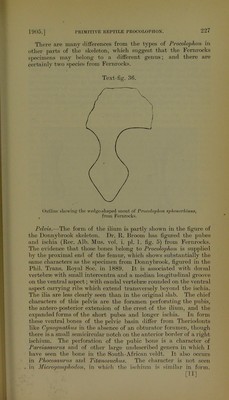
![There are many differences from the types of Procolophon in other parts of the skeleton, which suggest that the Fernrocks specimens may belong to a different genus; and there are certainly two species from Fernrocks. Text-fig. 36. Outline showing the wedge-shaped snout of Procolophon splienorliinus, , from Fernrocks. Pelvis.—The form of the ilium is partly shown in the figure of the Donnybrook skeleton. Dr. R. Broom has figured the pubes and ischia (Rec. Alb. Mus. vol. i. pi. 1. fig. 5) from Fernrocks. The evidence that those bones belong to Procolophon is supplied by the proximal end of the femur, which shows substantially the same characters as the specimen from Donnybrook, figured in the Phil. Trans. Royal Soc. in 1889. It is associated with dorsal vertebrae with small intercentra and a median longitudinal groove on the ventral aspect; with caudal vertebrae rounded on the ventral aspect carrying ribs which extend transversely beyond the ischia. The ilia are less clearly seen than in the original slab. The chief characters of this pelvis are the foramen perforating the pubis, the antero-posteiior extension of the crest of the ilium, and the expanded forms of the short pubes and longer ischia. In form these ventral bones of the pelvic basin differ from Theriodonts like Cynognathus in the absence of an obturator foramen, though there is a small semicircular notch on the anterior border of a right ischium. The perforation of the pubic bone is a character of Pareiasaurus and of other large undescribed genera in which I have seen the bone in the South-African veldt. It also occurs in Phocosanrus and Titanosuclms. The character is not seen . in Microgomphodon, in which the ischium is similar in form. [11]](https://iiif.wellcomecollection.org/image/b2241292x_0015.jp2/full/800%2C/0/default.jpg)


 No text description is available for this image
 No text description is available for this image
 No text description is available for this image