Elements of the comparative anatomy of the vertebrate animals : designed especially for the use of students / by Rudolph Wagner ; ed. from the German by Alfred Tulk.
- Rudolf Wagner
- Date:
- 1845
Licence: Public Domain Mark
Credit: Elements of the comparative anatomy of the vertebrate animals : designed especially for the use of students / by Rudolph Wagner ; ed. from the German by Alfred Tulk. Source: Wellcome Collection.
Provider: This material has been provided by the Francis A. Countway Library of Medicine, through the Medical Heritage Library. The original may be consulted at the Francis A. Countway Library of Medicine, Harvard Medical School.
41/284 page 27
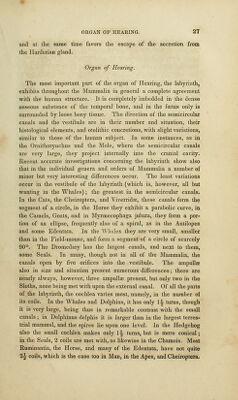
![and at the same time favors the escape of the secretion from the Harderian gland. Organ of Hearing. The most important part of the organ of Hearing, the labyrinth, exhibits throughout the Mammalia in general a complete agreement with the human structure. It is completely imbedded in the dense osseous substance of the temporal bone, and in the foetus only is surrounded by loose bony tissue. The direction of the semicircular canals and the vestibule are in their number and situation, their histological elements, and otolithic concretions, with slight variations, similar to those of the human subject. In some instances, as in the Ornithorynchus and the Mole, where the semicircular canals are very large, they project internally into the cranial cavity. Recent accurate investigations concerning the labyrinth show also that in the individual genera and orders of Mammalia a number of minor but very interesting differences occur. The least variations occur in the vestibule of the labyrinth (which is, however, all but wanting in the Whales); the greatest in the semicircular canals. In the Cats, the Cheiroptera, and Viverridae, these canals form the segment of a circle, in the Horse they exhibit a parabolic curve, in the Camels, Goats, and in Myrmecophaga jubata, they form a por- tion of an ellipse, frequently also of a spiral, as in the Antilopes and some Edentata. In the Whales they are very small, smaller than in the Field-mouse, and form a segment of a circle of scarcely 90°. The Dromedary has the largest canals, and next to them, some Seals. In many, though not in all of the Mammalia, the canals open by five orifices into the vestibule. The ampullae also in size and situation present numerous differences; there are nearly always, however, three ampullae present, but only two in the Sloths, none being met with upon the external canal. Of all the parts of the labyrinth, the cochlea varies most, namely, in the number oi its coils. In the Whales and Dolphins, it has only ] ^ turns, though it is very large, being thus in remarkable contrast with. the small canals ; in Delphinus delphis it is larger than in the largest terres- trial mammal, and the spires lie upon one level. In the Hedgehog also the small cochlea makes only 14*- turns, but is more conical; in the Seals, 2 coils are met with, as likewise in the Chamois. Most Ruminantia, the Horse, and many of the Edentata, have not quite 1\ coils, which is the case too in Man, in the Apes, and Cheiroptera,](https://iiif.wellcomecollection.org/image/b2108290x_0041.jp2/full/800%2C/0/default.jpg)