Report of the Royal Commission on the practice of subjecting live animals to experiments for scientific purposes : with minutes and evidence and appendix / presented to both Houses of Parliament by command of her Majesty.
- Great Britain. Royal Commission on Vivisection (1875)
- Date:
- 1876
Licence: Public Domain Mark
Credit: Report of the Royal Commission on the practice of subjecting live animals to experiments for scientific purposes : with minutes and evidence and appendix / presented to both Houses of Parliament by command of her Majesty. Source: Wellcome Collection.
Provider: This material has been provided by Royal College of Physicians, London. The original may be consulted at Royal College of Physicians, London.
125/1052 (page 95)
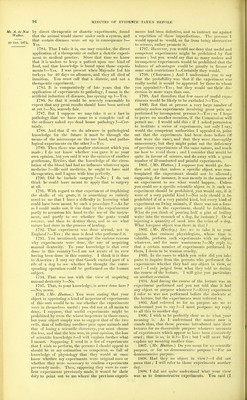
![thought-very justly) that no one could deny that the eye was a very much more powerful teacher than mere reading could be in such matters; but whether or not you justified experiments by that observation or condemned them, in spite of that observation, I could not quite understand ?—What I meant was this, that it is really going against, I was about to say common sense (I say it with deference), to say that the eye was not intended to instruct the mind. If I see certain phenomena evoked in an animal in the theatre I am much more likely to be impressed with everything concerning those phenomena than if I had only read about them ; but what T mean is that the knowledge of fiinctions is so easily understood by oral instruction and reading, that I do not consider demon- strations to be either necessary or j nstifiable ; and if it was otherwise, allow me to say that the greatest number of physicians and surgeons in practice would be nearly entirely ignorant of physiology, because since they attended lectures it has made tremendous strides ; and since 1868 all the knowledge which I have of modern physiology is from reading, and I find no difficulty in understanding it. You have heard, for example, that there are two sets of roots coming out of the spinal cord. If any one member of this Commission, not having received a medical education, were pointed out on the slate that the spinal cord gave out two roots, jind I upon the slate endeavoured to explain the different functions of these two roots, nothing could . The witne prevent any member of this Commission understanding Mr. A. de Noe thoroughly the functions of those roots. Walker. 1810. {3Ir. Forster.) You stated that you did not 9o Oct 1875 think that there was as much of these experiments at home as abroad. Have you any opinion as to wliether the experiments which are made in this countiy are generally made with anjesthetics, or not ?—The ques- tion of ansesthefics is not so very simple. When an experimenter says, for example, as is said in a very recent publication, that before and thi'oughout these experiments aufesthetics were used, it its perfectly true; but if by that you choose to understand that while the animal lived and was experimented on, he was throughout insensible, it is the greatest delusion that ever was. I have written a paper upon that very subject. Then with regard to the question of the excess of cruelty in this country, I am bound to say that I am not so competent a judge of what goes on in this country, as I am of what I have seen in foreign laboratories. I chiefly judge from publications, where I see, however, a great excess in the number of the ex- periments. I would have suspended from rank and pay, as we say in the army, a ceitain physician at a certain hospital for vivisecting 16 cats, upon which he performed the same experiments, and obtained iden- tical, or nearly identical, results. I do not consider him worthy to be an experimenter at all. I consider that a man who does that ought not to be licensed. withdrew. Dr. Lawson Cape, M.D., called in and examined. 1811. (Chairman.) You were formerly, I think, in practice in London, were you not ?—I was. 1812. You have now retired from practice?—I have. 1813. Are you in communication with the Society for the Abolition of Vivisection ?—I have seen Mr. Jesse ; I am not a member of that society. 1814. Are you aware that you are desired by them to appear and state your views to the Commission ?— No. 1815. Do you consider yourself identified in senti- ment with them ?—To a certain extent. 1816. You are desirous of stating to us your views on the subject ?—I am prepared to do so. 1817. Will you be so good as to state your views ? —My views on the point' are., that practitioners now and for the last 20 years and more, surgeons and physicians, have taken very good care of the public health without ever having attended anything in the way of vivisection; in the medical schools where they were educated there was no such thing as vivisection. 1818. And yoTi think that the recent introduction of that practice has not been called for by any necessity existing on the part of the public ?—Certainly it has not. 1819. Are you of opinion that any legislative measures are called for by the present disposition to extend that practice ?—T shoidd deprecate any exten- sion of the practice. 1820. Do you think that it was in former times carried too far ?—I have never seen it in England or in Scotland ; I was educated at St. Bartholomew's Hospital, and at Edinburgh, and lectured for ten years at St. Thomas's Hospital, and no such thing was heard of as vivisection. At the time I was in Paris for three winters and two summers, they had vivisection, but it was not recognised by the Ecole de Medicine or by the authorities at all; it was done on the sly, and they had dogs there for the tor- sion of arteries and so on. 1821. Is it your opinion that any legislative measures should prohibit experiments altogether, or that they should tolerate it and regulate it ?—I do not see how the public would be benefited, as far as medical advance or surgical advance goes, by the practice of vivisection in the medical schools. ]M 1822. Would you allow it'anywhere ?—It would depend upon the animals. T do not think that in the case of highly organized animals you would be j ustifled in performing vivisection upon them. 1823. Would you allow it in any case?—Well, it must be a strong case. 1824. But suppose it were what you would consider a strong case, would you think it justifiable then ?— I could not answer that question unless I had a strong case put before me. 1825. You are not prepared yourself to mention to the Commission any cases in which you would think it justifiable ?—No, I am not. 1826. You are not therefore prepared to recommend any set of provisions like that contemplated by Dr. Playfair, by which the Secretary of State should license certain persons to perform such experiments ? —I think that license ought to be guarded by certain regulations. 1827. But yon would contemplate such a system if it were properly guarded ?—If it were properly guarded. 1828. Are you prepared to suggest to the Commis- sion anything that you would consider to be proper security ?—Whatever physiological question may have to be decided, if it could be done by experiments upon the lower animals, I should say that that would be preferable to experiments on the higher oniis; I mean the more highly organized ones, fully orgaii'zed ones, like the dog. 1829. By lower animals what do you mean ?— There are all the phases of animal life below those to which I have referred, and the lower they are the less the nervous system is developed, and the less the pain. I do not think there is much pain, for instance, in a worm to fish with. It has no brain, and I do not think that it suffers, although the popular notion is that it does. 1830. Then you are not prepared to suggest any detailed scheme by which the Commission could propose to regulate a system of experiments on living animals?—I have not had the advantage of reading Dr. Playfair's suggestions about that. 1831. They would empower the Secretary of State to license certain persons to conduct experiments ?— I think that is the way it ought to be done. 4 Dr. L. Cape. M.D.](https://iiif.wellcomecollection.org/image/b23983334_0127.jp2/full/800%2C/0/default.jpg)