Report of the Royal Commission on the practice of subjecting live animals to experiments for scientific purposes : with minutes and evidence and appendix / presented to both Houses of Parliament by command of her Majesty.
- Great Britain. Royal Commission on Vivisection (1875)
- Date:
- 1876
Licence: Public Domain Mark
Credit: Report of the Royal Commission on the practice of subjecting live animals to experiments for scientific purposes : with minutes and evidence and appendix / presented to both Houses of Parliament by command of her Majesty. Source: Wellcome Collection.
Provider: This material has been provided by Royal College of Physicians, London. The original may be consulted at Royal College of Physicians, London.
127/1052 (page 97)
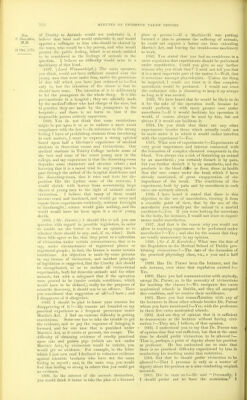
![therefore is a giving way of the internal coat of an artery. There is another form which consists in the enlargement of the artery; hut there is an aneurism, which is the ordinary case, which consists in the giving way of the internal coat of the vessel. The blood becomes then propelled against the yielding coat; the blood forms a pul- sating tumour, and that is what we-call an aneurism. Up to that time I must tell you that the operation on that disease was a very formidable operation, and too frequently fatal. It consisted in opening the sack and tying the artery on both sides of it. This was found to be a very bad operation, frequently attended with fatal consequences. I need not detain you with telling you the process. Now Mr. Hunter said that the cause of that wsis that the artery was tied in a spot where it was diseased, and that if he tied the artery in a sound part he would most likely find that the thing would do very well. He accordingly did so, and the operation proved successful; and that has been certainly a very desirable and excellent improve- ment in the practice of surgery. But there was not a single thing with regard to it that he could have dis- covered in a living animal. Now the thing which has probably caused some unthinking persons to infer that is this. There was a great contest at the time. They said that Mr. Hunter is wrong, and that the arteries were generally diseased. Then Mr. Hunter made an experiment on an animal, that is to say, he tried to make an aneurism. He bared an artery, and he dissected off the coats of the artery, only leaving the intei'nal coat, so as to make it as weak as he could, and then he bound up the wound ; but after a time he killed the animal, opened the wound, and found that everything had healed, just as if nothing had been the matter. In flxct, he could not make an aneurism, and as animals do not have aneurisms, but only the human subject, it is quite clear that there is not a shadow of shade of evidence that his discovery was the result of experiments on animals. 1847. Your opinion, I gather, is that experiments on living animals do not conduce to the cure of infir- mities, whether surgical or medical, in the human frame ?—I have a most matured conviction of that. 1848. Is all this set forth at length in the volume that you have been so good as to bring to our notice ? —No ; not at length. 1849. But I mean at as much length as would be possible for us to take in examination ?—Yes ; I sliould think it would. 1850. Have yoxi in any way changed your opinions, or seen any reason to modify them since ?—Not the least; on the contrary, everything which I have seen since has convinced me, not merely that physiological investigation by meaias of dissecting living animals is an inauspicious mode of proceeding, because it violates tlie first principles of inductive philosophy, as also of lo^ic, but that it actually has led to most serious prac- tical errors. I know of no error in the whole practice of surgery (and now I am obliged to mention myself, which is not a very pleasant thing) which has pro-, duced an evil equal to that which I myself have practically corrected, and that is the employment of j)urgatives after the operation in strangulated hernia. 1851. lias that mistake resulted from experiments on living animals ?—Yes ; and now I Avish to show you that. I must tell you that strangulated hernia wa^;, and is now, a very dangerous disease. The intestine escapes from its natural cavity. It is con- stricted by the tendinous structure through which it escapes, and the consequence is that the case is a very uncertain one ; I have seen a, patient escape after days, and I have seen mortification take place within an liour or two; so that it. is a case of great gravity. The operation consists of cutting down to the part and enlarging the opening of the tendinous structure and replacing it. Now, of course, it is a very natural iinxiety for a man to know whether the bowels have acted, because that is a direct proof that the stricture has been- removed, but that led to a most grievous mistake. And now I must go back to the experiments. Mr. Travers made experiments on dogs. His book is Mr. entitled On Injuries of the Intestines and on G. Macilwain, Strangulated Hernia. He made some experiments F.R.C.S. on animals, and divided the intestines and sewed up Oct 1875 the wound and guts, and did a great many things of that kind, and showed that animals have certainly very great powers of repair under such circumstances. But now the inductive philosophy comes in. He left out some of the most important parts of the subject as regarded the human subject because he never purged these dogs. If he had wanted to carry the analogy close for strangulated hernia he should have placed the dog (even supposing it was feasible to do any- thing with the dog at all), as nearly as possible under the same circumstances as the human subject. But now mark the difierence, and just mark the conse- quence. He does no such thing ; but he goes on to the treatment of strangulated hernia, and lie says that after the operation the great thing is to get a discharge from the bowels (now this is true); and the great danger is from the inflammation of the peritonoeum, that is the membrane covering the bowels, and lining the interior of the body ; and he says that ]3urgatives are the great thing ; that if there is no peritonitis, we use purges to prevent it, and if there is peritonitis, then we tise purges to cure it. Now you must allow me just to refer to that passage, because this is a matter of extreme consequence. T shall not ex- aggerate if I tell you that a difference in practice saves in Europe, I should say hundreds of lives every year ; and I will show you exactly how it was arrived at, because I did it myself, although it is very difficult to claim anything for oneself. In the same book m which Mr. Travers published these experiments he also published the treatment of strangulated hernia ; he gave his directions for the treatment which is exactly that which destroys the patient. 1852. Without putting you to the trouble of reading the quotation, we understand yoti to say that you mention the case of Mr. Travers's exjieriments upon animals in regard to strangulated hernia as a proof that such experiments may not only not lead in the right direction, but may be absolutely misleading ?— Yes ; if you add to that and the practice he deduced from them. At present you have only my word for this fact. But now here comes a very extraordinary circumstance. Here is the transcript of a lecture, the part I refer to being only a few lines, from a gentleman whose mistake induced me first to write upoii that subject, and which has been the means of my having any power of claiming that improvement as my own. I could not get him to refrain from giving purgatives, and the patient died. That same gentleman, Mr. Stanley, of St. Bartholomew's Hospital, in lecturing to his pupils some 20 years afterwards, or more than that, says as follows : That at one time purgatives were employed in these cases, whereas it is now'perfectly understood that they ought not to be so employed, and he had himself had bushels from cases of strangulated hernia—cases where the fatal peritonitis was traceable to the purge. 1853. {Sir J. B. Karslake.) You practised vivi- section many years ago yourself, I understand you to say ?—I did a little, but that was very early indeed. 1854. Your view is that vivisection is wholly use- less, and worse than useless ?—It is; and I beg leave to say this, that I have on several occasions offered in print to take any number of experiments which the profession were desirous of putting in force, or in which they had confidence, with the desire to give them my most respectful consideration. 1855. 1 understood you to say that if you could be induced to believe that vivisection was absolutely necessary you would not hesitate to practice it merely on the ground of the cruelty which is inflicted on animals ?—I do not say so. 1856. Yoti said it Avas not a question of cruelty, did you not?—I said it had not been with me; but I began like other people making great mistakes, and 1 have endeavoured to correct them. I wish not to N](https://iiif.wellcomecollection.org/image/b23983334_0129.jp2/full/800%2C/0/default.jpg)