On the theory and practice of midwifery / By Fleetwood Churchill ... With notes and additions, by D. Francis Condie.
- Fleetwood Churchill
- Date:
- 1853
Licence: Public Domain Mark
Credit: On the theory and practice of midwifery / By Fleetwood Churchill ... With notes and additions, by D. Francis Condie. Source: Wellcome Collection.
Provider: This material has been provided by the Harvey Cushing/John Hay Whitney Medical Library at Yale University, through the Medical Heritage Library. The original may be consulted at the Harvey Cushing/John Hay Whitney Medical Library at Yale University.
123/540 page 131
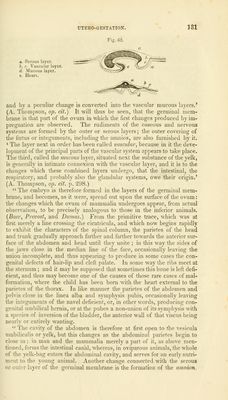
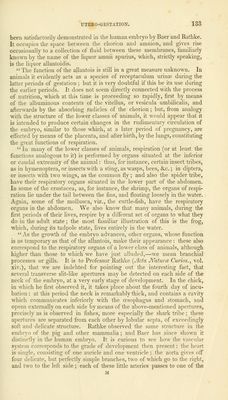
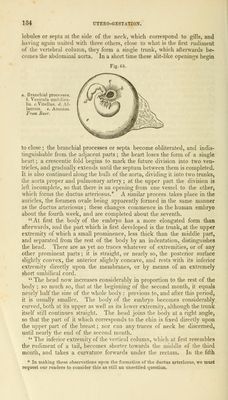
![a. Serous layer. b, c. Vascular layer. d. .Mucous layer. e. Heart. and by a peculiar change is converted into the vascular mucous layers.' (A. Thompson, op. cit.) It will thus be seen, that the germinal mem- brane is that part of the ovum in which the first changes produced by im- pregnation are observed. The rudiments of the osseous and nervous systems are formed by the outer or serous layers; the outer covering of the foetus or integuments, including the amnios, are also furnished by it. 1 The layer next in order has been called vascular, because in it the deve- lopment of the principal parts of the vascular system appears to take place. The third, called the mucous layer, situated next the substance of the yelk, is generally in intimate connexion with the vascular layer, and it is to the changes which these combined layers undergo, that the intestinal, the respiratory, and probably also the glandular systems, owe their origin.' (A. Thompson, op. cit. p. 298.) The embryo is therefore formed in the layers of the germinal mem- brane, and becomes, as it were, spread out upon the surface of the ovum: the changes which the ovum of mammalia undergoes appear, from actual observation, to be precisely analogous to those in the inferior animals. (Baer, Prevost, and Dumas.) From the primitive trace, which was at first merely a line crossing the cicatricula, and which now begins rapidly to exhibit the characters of the spinal column, the parietes of the head and trunk gradually approach farther and farther towards the anterior sur- face of the abdomen and head until they unite ; in this way the sides of the jaws close in the median line of the face, occasionally leaving the union incomplete, and thus appearing to produce in some cases the con- genita] defects of hair-lip and cleft palate. In some way the ribs meet at the sternum ; and it may be supposed that sometimes this bone is left defi- cient, and thus may become one of the causes of those rare cases of mal- formation, where the child has been born with the heart external to the parietes of the thorax. In like manner the parietes of the abdomen and pelvis close in the linea alba and symphysis pubis, occasionally leaving the integuments of the navel deficient, or, in other words, producing con- genital umbilical hernia, or at the pubes a non-union of its symphysis with a species of inversion of the bladder, the anterior wall of that viscus being nearly or entirely wanting. The cavity of the abdomen is therefore at first open to the vesicula umbilicalis or yelk, but this changes as the abdominal parietes begin to close m ; in man and the mammalia merely a part of it, as above men- tioned, forms the intestinal canal, whereas, in oviparous animals, the whole of the yelk-bag enters the abdominal cavity, and serves for an early nutri- ment to the young animal. Another change connected with the serous or outer layer oi the germinal membrane is the formation of the amnion.](https://iiif.wellcomecollection.org/image/b21030133_0123.jp2/full/800%2C/0/default.jpg)
 No text description is available for this image
 No text description is available for this image
 No text description is available for this image