Volume 1
Observations on popular antiquities: chiefly illustrating the origin of our vulgar customs, ceremonies, and supersititions ... / arranged and revised, with additions, by Henry Ellis.
- John Brand
- Date:
- 1813
Licence: Public Domain Mark
Credit: Observations on popular antiquities: chiefly illustrating the origin of our vulgar customs, ceremonies, and supersititions ... / arranged and revised, with additions, by Henry Ellis. Source: Wellcome Collection.
31/522 page 27
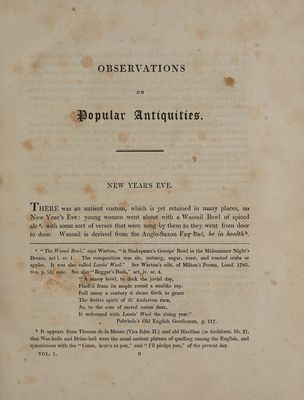
![OBSERVATIONS ON ‘Popular Antiquittes. NEW YEAR'S EVE. Tuere was an antient custom, which is yet retained in many places, on New Year’s Eve: young women went about with a Wassail Bowl of spiced ale*, with some sort of verses that. were sung by them as they went from door to door. Wassail is derived from the Anglo-Saxon Ver Del, be in health’. 2 < The Wassel Bowl,” says Warton, “ is Shakspeare's Gossips’ Bow] in the Midsummer Night's Dream, acti. sc. 1. The composition was ale, nutmeg, sugar, toast, and roasted crabs or apples. It was also called Lambs’ Wool.” See Warton’s edit. of Milton’s Poems, Lond. 1785, Svo. p. 51, note. See also ‘‘ Beggar's Bush,” act iv. sc. 4. — “A Massy bowl, to deck the jovial day, Flash’d from its ample round a sunlike ray. Full many a century it shone forth to grace The festive spirit of th’ Andarton race, As, to the sons of sacred union dear, It welcomed with Lambs’ Wool the rising year.” Polwhele’s Old English Gentleman, p. 117. 7’ > It appears from Thomas de la Moore (Vita Edw. II.) and old Havillan (in Architren. lib, 2), that Was-haile and Drinc-heil were the usual antient phrases of quafling among the English, and synonimous with the “Come, here’s to you,” and “Ill pledge you,” of the present day.](https://iiif.wellcomecollection.org/image/b33520227_0001_0031.jp2/full/800%2C/0/default.jpg)
 No text description is available for this image
 No text description is available for this image
 No text description is available for this image