Volume 1
Observations on popular antiquities: chiefly illustrating the origin of our vulgar customs, ceremonies, and supersititions ... / arranged and revised, with additions, by Henry Ellis.
- John Brand
- Date:
- 1813
Licence: Public Domain Mark
Credit: Observations on popular antiquities: chiefly illustrating the origin of our vulgar customs, ceremonies, and supersititions ... / arranged and revised, with additions, by Henry Ellis. Source: Wellcome Collection.
36/522 page 6
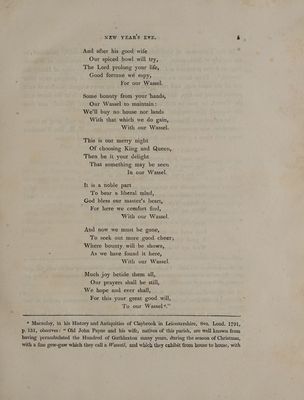
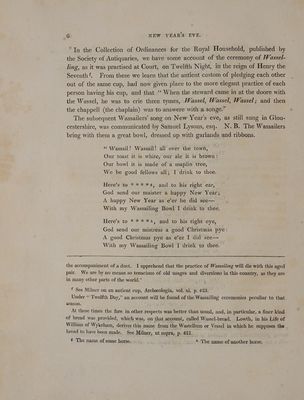
![‘In the Collection of Ordinances for the Royal Household, published by the Society of Antiquaries, we have some account of the ceremony of Wassel- ling, as it was practised at Court, on Twelfth Night, in the reign of Henry the Seventh‘. From these we learn that the antient custom of pledging each other out of the same cup, had now given place to the more elegant practice of each person having his cup, and that ‘‘ When the steward came in at the doore with the Wassel, he was to crie three tymes, Wassel, Os Wassel; and then the chappell (the chaplain) was to:‘answere with a songe.” The subsequent Wassailers’ song on New Year's eve, as still sung in Glou- cestershire, was communicated by Samuel Lysons, esq. N.B. The Wassailers bring with them a great bowl, dressed up with garlands and ribbons. ‘¢ Wassail! Wassail! all over the town, Our toast it is white, our ale it is brown: Our bowl it is made of a maplin tree, We be good fellows all; I drink to thee. Here’s to * ** *, and to his right ear, God send our maister a happy New Year; A happy New Year as e’er he did see— With my Wassailing Bowl I drink to thee. Here’s to * * * *h, and to his right eye, God send our mistress a good Christmas pye: A good Christmas pye as e’er I did see— With my Wassailing Bowl I drink to thee. the accompaniment of a duet. I apprehend that the practice of Wassailing will die with this aged pair. We are by no means so tenacious of old usages and diversions in this country, as they are in many other parts of the world.” f See Milner on an antient cup, Archzologia, vol, xi. p. 423. Under «Twelfth Day,” an account will be found of the Wassailing ceremonies peculiar to that season. At these times the fare in other respects was better than usual, and, in particular, a finer kind of bread was provided, which was, on that account, called Wassel-bread. Lowth, in his Life of William of Wykeham, derives this name from the Wastellum or Vesse] in which he supposes the bread to have been made. See Milner, ut supra, p. 421. & The name of some horse. «. | _ _. » The name of another horse.](https://iiif.wellcomecollection.org/image/b33520227_0001_0036.jp2/full/800%2C/0/default.jpg)
 No text description is available for this image
 No text description is available for this image
 No text description is available for this image