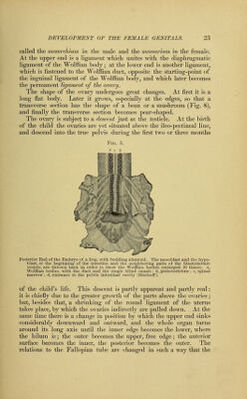
A text-book of the diseases of women / by Henry J. Garrigues.
- Garrigues, Henry J. (Henry Jacques), 1831-1913.
- Date:
- 1894
Licence: Public Domain Mark
Credit: A text-book of the diseases of women / by Henry J. Garrigues. Source: Wellcome Collection.
Provider: This material has been provided by the Francis A. Countway Library of Medicine, through the Medical Heritage Library. The original may be consulted at the Francis A. Countway Library of Medicine, Harvard Medical School.
32/750 page 22
![vesicles appear now as branches of the Wolffian duct (Fig. 5), which grow rapidly and connect at the other end with arterial tufts in the same way as the uriniferous ducts and the Malpighian tufts in the kidneys. In the male the Wolffian body later is transformed into the epidi- didymis and the organ of Giraldez (Fig. 6); in the female into Rosen- Ftg. 4. The Genital and Urinary Organs of the Embryo of Cattle : 1, from a female embryo 1^ inches long (double size): w, Wolffian body ; wg, Wolffian and Mullerian ducts ; i, inguinal ligament of Wolffian body ; o, ovary with an upper and lower peritoneal fold; n, kidney; m, suprarenal body; g, genital cord, composed of the united Wolffian and Mullerian ducts. 2, from a male embryo 2]4 inches long (nearly three times natural size): one of the testicles has been removed. Letters as in Fig. 1, and, besides, m, Mullerian duct; m', upper end of the same ; ft, testicle ; ft', lower ligament of testicle ; ft, upper ligament of testicle; d, diaphragmatic ligament of Wolffian body ; a, umbilical artery; v, bladder. 3, from a female embryo (enlarged nearly three times). Letters as in Figs. 1 and 2, and, be- sides, t, opening of the upper end of Mutter's duct; o', lower ovarian ligament; u, thick- ened part of Mullerian duct, which later becomes the uterine horn (Kofliker). mutter's organ, or the parovarium, and stray tubes found between the parovarium and the uterus (Fig. 7). The Ovaries. In the beginning the sexual glands are identical in both sexes. At the end of the second month the ovary and the testicle begin to differ from one another, the testicle becoming broader and shorter, while the ovary stays long and narrow. The ovary has a much more developed columnar epithelium than the testicle. The sexual glands are situated on the inner side of the Wolffian body (Fig. 4), to which they are fastened by a fold of the peritoneum](https://iiif.wellcomecollection.org/image/b21053881_0032.jp2/full/800%2C/0/default.jpg)