Cambria triumphans, or Brittain in its perfect lustre shewing the origen and antiquity of that illustrious nation. The succession of their kings and princes, etc / [Percy Enderbie].
- Percy Enderbie
- Date:
- [1810]
Licence: Public Domain Mark
Credit: Cambria triumphans, or Brittain in its perfect lustre shewing the origen and antiquity of that illustrious nation. The succession of their kings and princes, etc / [Percy Enderbie]. Source: Wellcome Collection.
435/456 page 363
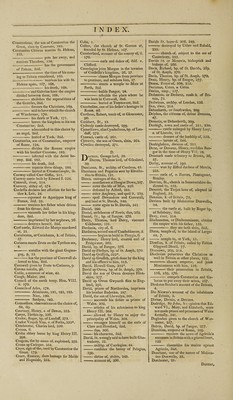
![Christ, Pilate’s account of our Saviour’s passion in his letter to Tiberius, 87. Christianity begins to flourish in Britain, 9$- - — tolerated in Britain by the Ro¬ man lieutenants, 131. .-abolished in places where the Saxons seated themselves, ii. 192. Christians encouraged by Antoninus Pius, 128. --persecuted by Severus, 143. ■ the persecution of them under Dioclesian, 144. --persecuted in the time of As- clepiodotus by Dioclesian and Maximi- an, 156. Chrysanthus, 125. ■ --- deputy of Britain, I89. Churches, cathedral and other, in the time of Lucius, 138. --erected and reedified in the time of Constantine the Great, 172, 178. --destroyed in Britain in Diode- sian’s persecution mostly reedified under Constantine, 17-3. Chynemarces, v. Kymmachus. Cicuber, v. Lud. Cilgerran castle, 278. --besieged by the e. of Pembroke, 292. Cimaron castle built, 289. Cingetorix, 84. Cirencester, 21. Cissa persecutes the monks of Abingdon, ii. 182. ■ -comes into Britain with his father Ella, ii. 184. Cissancester, 21. Cities of Britain as enumerated by Gildas and Ran. Higden, 21. Clare, Gilbert de, e. of Gloucester, 91, 227, 264, 297. Clare, Hubert de St., saves k. Henry II’s life, 278. Clare, Richard de, e. of Gloucester, 91, 297- - surnamed Strongbow, 227. Clare, Roger, earl of, desires such lands in Wales as he could win, 275. Clare, Walter de, founds Tintern abbey, 2 57. Clarence, duke of, 54, 55, 60. Classianus, Julius, succeeds Catus, 115. -- endeavours to conciliate the Britons, ibid. -- writes letters to Rome to the prejudice of Suetonius Paulinus, ibid. Claudia, the British lady, and others of her family become Christians, 97. -- receives St. Peter, ibid. - her birth, 98. -- wife of Pudens, 99, 100. -- her great piety, 99. Claudia, St., 129, 134. Claudius gave Plautius the first prefect of Britain, 3. --reduces the Orcades and Angle¬ sey under the subjection of the Romans, 89. a temple erected to him by the Britons, 96, 111. -saluted Imperator, ibid. 124, 157. .-sets out on his expedition against Britain, 96. _embarks at Gessoriacum in Gal¬ lia, ibid. _joins Plautus and Vespasian, ib. ._continues but sixteen days in Britain, ibid. -dies of poison, 107. Clausentum, a fort ot the Romans, now Southampton, 89. Clavus, archbp. of London, 126. Cledauc, bp. of St. David’s, 266, 267. Cledhen, two rivers of the name of, 216. Clement, St., bp. of Metz, 96, 97, 103. -accompanies St. Mansuetus, 98. Clifford, Francis, e. of Cumberland, ii. 176. Clifford, George, e. of Cumberland, ii. 176. Clifford, Henry, e. of Cumberland, ii. 176. Clifford, Robert, 324. Cloddien ap Gurgan, bp. of Dryswyn, 333*. Clotenus accompted among the kings of Britain, 75. Clovensis, John, bp. of Bangor, 277* Clun burnt, 299. Clun castle, 212. Clusium besieged by the Gauls, 38. Clwyd, river, 214. Clydawe, the son of Cadeth, slain, 235. Coe], or Coilus, birth of, 93. -made k. of Britain, 73, 130, 154, 156, 157. -educated among the Romans, 130. -pays tribute, ibid. -the building of Colchester ascribed to him, ibid. -chronology of his reign, 138. -a friend to the Christians, 157- Colchester, 21. •-the building of, ascribed to Coill, or Coillus, k. of Britain, 130. ■' ■ Lucius, Helena, and Con¬ stantine, born at, ibid. -description of the city of, ibid. - graced with the honour of a viscount by k. James, 131. Colgrime, or Colgerne, vanquished by Arthur, ii. 188. -- goes to Germany, ibid. - returns, and is again vanquish¬ ed, ibid. - invades the west parts of Bri¬ tain, ibid. - slain by Arthur, ibid. Comet, 235, 256. Cominius, Pontius, conveys Camillus’s intention to the Romans besieged in the Capitol, 41. Comius, chief governor of the Attrebates, 79- Comius of Arras, Caesar’s messenger, re¬ leased, 81. Commodus, Aurel., emp. of Rome, 123. -sends Ulpius Marcellus into Britain, 139. -the army in Britain refuse to acknowledge him as emperor, ibid. ■ false report of his death, 140. --favourable to the Christians, ibid. Commonwealth, three things which up¬ hold, and three things which subvert a, 73. Comots, subdivision of, 209, 210, 211, 212, 214. Conan, ii. 174. Conan, e. of Richmond, 53. Conan the son of Elise receives poison, 238. Conan the son of Howel aspires to the rule of North-wales, 241. -is slain, 242. Conan the son of Jago, 244. Conan Tindaythwy reigns over the Bri¬ tons, 206. _____ falls at variance with his brother Howel, ibid. ____. chases him out of Anglesey, 207 - _-— dies, ibid. Conanus, archbishop of London, 126. Conanus, one of the commanders of Maximus’s army, 188. Conanus, Aurelius, raises war against Con¬ stantine, 198. •-made k. of Britain, 199. -dies, leaving the crown to Vorti- porus his son, ibid. ■ -Gildas’s account of him, ibid. Connuvenna, or Conwenna, reconciles Brennus and Bellinus, 37. Conobelin governs theTroynobantes, 85. - coins of, ibid. ■ - at Rome when our Saviour was born, ibid. Conobertus, 204. Conon of Meriadoc the first prince of the British blood in Armorica, 204. Constans, emperor of Rome, 124. Constans and Constantius divide the Ro¬ man empire between them, 182. -seizes upon the provinces which Constantinus had held, ibid. -is slain by Magnentius Taporus, ibid. Constantine the Great fulfils the oracle concerning Brute, 31. ■ -- emperor of Rome, 124. -his birth, 168. -instructed in Christianity in Britain, 169. -escapes from Italy, and comes to York at the time of his father’s sick¬ ness, 171. -attends his father’s funeral procession, ibid. -proclaimed emperor, 172. -favours the Christians, ibid. ————— invited to turn his arms against Maxentius, 174. ———— overcomes him, 172, 173. -reedifies the church of Win¬ chester, 172. - declared sole emperor, 173. ——— his vision, 174. -places the image of the cross as a sign of victory before his army, 175. -learned the Christian faith in Britain of his mother St. Helena, ibid. 177- --—compared with Naaman of Syria, 176. --recommended by the Pagan physicians to cure his leprosy by bath¬ ing in the blood of infants, ibid. - St. Peter and St. Paul appear to him, ibid. -his edicts for the establish¬ ment of Christianity, 176. --baptised, ibid. 177- . . - causes the sign of the cross to be put upon his soldiers’ armour, 179. __- carries a pavilion after the manner of a church with his army, ibid. -takes away the Roman pu¬ nishment of the cross, ibid. -alters the government of Bri¬ tain, ibid. --removes the imperial seat to Byzantium, ibid. .-reported by some authors to have had an army of Britons in his pay, ibid. --wars in Persia, ibid. --builds the church of the apo¬ stles at Constantinople, ibid. 180. .-. dies in Bithynia, ibid. -his body conveyed to Con¬ stantinople, ibid. Constantine, kinsman to k. Arthur, made k.of Britain, 198. —- subdues the sons of Mordred, ibid. .--- slain by Aurelius Conanus, ib. -his cruelty and vices, 203. Constantinople, the church of the apostles at, 180. Constantinus,](https://iiif.wellcomecollection.org/image/b30458213_0435.jp2/full/800%2C/0/default.jpg)