First report of the Royal Commission appointed to inquire into arsenical poisoning [1900] from the consumption of beer and other articles of food or drink.
- Great Britain. Royal Commission on Arsenical Poisoning
- Date:
- 1901-1903
Licence: In copyright
Credit: First report of the Royal Commission appointed to inquire into arsenical poisoning [1900] from the consumption of beer and other articles of food or drink. Source: Wellcome Collection.
Provider: This material has been provided by London School of Hygiene & Tropical Medicine Library & Archives Service. The original may be consulted at London School of Hygiene & Tropical Medicine Library & Archives Service.
114/872 page 28
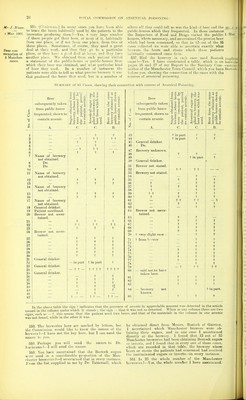
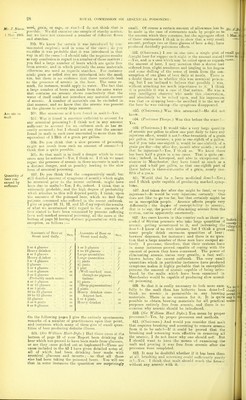
![used, grain, or sago, or rice?—I do not think that is posfible. A\'e did examine one sample of starchy matter, but wc have not exaanined a number of different flours —~ and starches. -595. We know for certain it was introduced by con- Trtminated sulphuri'e acid in some of the cases ; do you fyji;sider it was probable that it was introduced in that way in all the cases ?—I should take the negative results IS very conclusive in regard to a num.'ber of these matters ; you find a large number of beers which are quite free from arsenic, and in which precisely the same materials otherwise are used as regards starches. For instance crude grain or rolled rice are introduced into thic mash tun, but there is no evidence that these materials lead to the presence of ai'senic in the beer. The same re- mark, for instance, would apply to water. The fact that a large number of beers are made from the same watei that oont^ains no arsenic shows conclusively that the water of itself oould not introduce any material amount of ai-senic. A number of materials can be excluded in that manner, and we know that the arsenic was present in the glucose to a.very large amount. Ai'Siuic in 596. Has arsen-oxis acid bsen found in malt?—Yes. 597. Was it found In amounts sufiieient to account for any arsenical poisoning?—I think not in any amount sufficient- to account for an outburst such as has re- cently occurred ; but I should not say that the amount found in malt in each case amounted to more than the equivalent of l-25th of a grain jjer gallon. 598. Do you think that a slow process of poisoning might not result from such an amount of arsenic I—I think that is quite possible. 590. So that malt is in itself a danger which in some cases may be serious ?—Yes, I think so. I th'ink we must regarc tlie presence of arsenic in those amounts in malt as a distinct danger, and as possibly leading to the slow form of arsenical poisoning. Quantity of -^'^ think that tlie comparatively small, but beer con- still decided amount of symptoms of neuritis which might Bumed by be arsenical prior to the recent outbreak, might have sufferers been due to malts ?—Yes, I do, indeed. I think that is extremely probable, and the high degree of probability wlueh attach.es to this will depend partly, I tiiink, upon the amounts of the poisoned beer, which we fijid that patients consumed who suffered i:i the recent outbreak. I give on pages 10, 11, 12, and 13 of my report the results of what we ascertained ^yith regard to the amounts of beer stated to have been consumed by persons suffering frcQ well-marked arsenical poisoning, all the cases at the bottom of page 10 having distinct pigmentation with one exception, as follows: — Amounts of iBeer or Stout used daily. Amounts of Beer or Stout used daDy. 3 or 4 glasses iHeavy drinker - 4 or 5 glasses Heavy diinker - 3 o • 4 glasses 2 glasses 3 or 4 glasses 5 or 6 glasses 2 or 3 gla^sses (Probably much more) 4 or 5 glasses 8 or 10 glasses . - 4 or 5 pints 10 to 12 glasses - 10 to 12 glasses - 12 glasses - 5 or 6 pints 8 or 9 glasses / / / / / / / m m m m m 4 or 5 glasses 8 to 10 glasses - Large quantities Large quantities \h pints A-l pints - 1 jiint (Well-marked case, though no pigmen- tation) I5 pints (Deep pigmentation) 2 pints Heavy drinker since August last. 3 or 4 jjints Hea\'y drinker - Sex. / ./ / / / / m m ■m On the following pages I give the entirely spontaneous remarks of a number of practitioners upon that point, and instances which many of them give of small quan- tities of beer producing definite illness. 601. (Sir William Hart-Dylce.) iHad these cases at the bottom of page 10 of your Report been drinking the beer which was proved to have been made from glucoses, or are they cases picked out at haphazard ?—These are cases included in the 63 I hare given detailed notes of, all of whieh had been drinking beer made with arsenical glucoses and inverts ; ' so that all these «-Ls.i had been taking the poisone<l beers. You will see that in some instances the quantitdes are surprisingly- small. Of course a certain amount of allowance has to- jf£,^ j bo made in the ease of statements made by people as to the amount which they consume, but ihe aggregate effect 1 Mar.. ] of these statements I think is to show that a very small —^ amount, perhaps two or three glasses of beer a day, have prnduced decidedly poisonous effects. 602. (Chairman.) I see in one case a single pint of small ilraught beer for supper each night is the amoimt stated ? titles in : —Yes, and m a case which may be relied upon as regards cases, the amount of beer, I may mention that a doctor had suffered from slight numbness and tingling ui his fingers and some dulling of the sense of touch from the con- sumption of one glass of beer daily at meals. There is a doubt there as to whether this was arsenical poison- ing, but I am inclined to believe that possibly it was, without attaching too much importance to it. I think it is possible it was a case of that nature. iHe was a very intelligent observer who made this observation., and absolutely to be relied upon, and his impression was that on stopping beer—he ascribed it to the use of the beer he was taking—the symptoms disappeared. 603. {Chairman.) Was this arsenical?—iHe did not ki'.ow. 604. {Professor Thorpe.) Was this before the scare ?— Yes. 605. {Chairman.) It wotild take a very large quantity of arsenic per gallon to allow one pint daily to have any injurious eifeot, would it not?—One-twentieth of a graire per gallon, for instance, a pint is one-eighth of a gallon, and if you take one-eigiith it would be one-sixtieth of a grain per day—daiy after day, month after month ; would that be injurious?—Yes, I think so. We know there has been half a grain in some cases. That is quite cer- tain ; indeed, in Liverpool, and also in exceptional in-: stances in iManchester, they have found as much as a grain and a-half per gallon, so that one-eighth part of three halves is three-sixtcenthis of a grain, nearly one- fiftlt of a grain. 6C{j Would that b& ?. larf^e medicinal dose?—^Yes ; and I think quite capable of producing marked symp- toms. 607. And taken day after day might be fatal, or very injurious?—^It wotild be very injurious, cei+ainly. One does not like to go too far, but that certainly might be so in susceptible people. Arsenic affects people very differently ; the degree of susoeptibilityi to arsenic, that is to say, the power of elianlnating arsenic from the system, varies apparently enormously. 608. Are cases known in this country such as those re- ccrded of Styrian peasants who take large quantities of arsenic, getting accustomed to it, and increasing the dose?—know of no such instance, but I think a great many people drink enormous quantities of beer; brewers' draymen, for instance ; and there is no ques- tion that a large number of these men have escaped en- tirely. I presume, therefore, that their systems have in many instances proved capable of coping with the amount of poison they have consumed. The power of eliminating arsenic varies very greatly, a fact well- known before the recent outbreak. The very small quantities which in particular instances have produced symptoms makes it highly probable that in susceptible persons the amount of arsenic capable of being intro- duced by the malts which have been examined in iManchester would be capable of producing slow arseni- cal poisoning. 609. So that it is really necessary to look more care- fully to the malt tlian has hitherto been done?—I think no arsemic is permissible in any brewing materials. There is no occasion for it. It is quite possible to obtain brewing materials for all practical purposes entirely free from arsenic, and there is no occasion why arsenic should be introduced. 610. {Sir William Hart Dyke.) You mean by proper processes?—^Yes, by proper processes and methods. 611. {Chairman.) And would you consider that malt that requires brushing and screening to remove arsenic from it to be safe?—itf it could be proved that the brushing and screening were effective in removing all the arsenic, I do not know why one should not. But I should want to have the means of examining the malt and proving it was free from arsenic after the processes were completed. 612. It may be doubtful whether if it has been there at all, brushing and screening could sufficiently purify it?—Yes. I think that malt should reach the brewei- without any arsenic -with it. Indivii suscep lility t fcnic No ar shoulc permi any b mater](https://iiif.wellcomecollection.org/image/b21353086_0114.jp2/full/800%2C/0/default.jpg)



 No text description is available for this image
 No text description is available for this image
 No text description is available for this image