Feeding and care of baby / by F. Truby King, issued by the Royal New Zealand Society for the Health of Women & Children (Incorporated).
- Truby King
- Date:
- 1925
Licence: In copyright
Credit: Feeding and care of baby / by F. Truby King, issued by the Royal New Zealand Society for the Health of Women & Children (Incorporated). Source: Wellcome Collection.
118/170 page 112
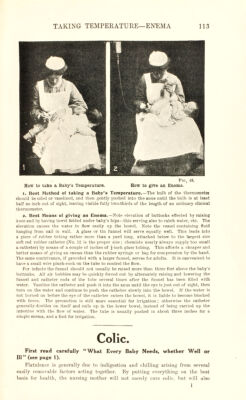
![suddenly with persistent vomiting, prostration, diarrticea and fever. If this should occur let the child have cold boiled water to drink and give an enema of a quarter pint of warm water (between 90 and 100 deg. F.). If a nurse is present she should irrigate copiously with normal saline solution, gradually reducing the temperature of the fluid to as low as 70 deg. F. if there is high fever. A doctor should be called in immediately. There would be no risk of grave, sudden emergencies such as the above if mothers would pay due attention to the essentials of hygiene (page 1), especially suitable dieting and the hygiene of the bowels (see page 62). Enema. If a baby is troubled with constipation, a small tonic enema of ^ to 1 ounce of “ normal saline ” (a level teaspoonful of common salt to a pint of boiled water) may be given by means of a tiny soft-nozzled bulb-enema pending the securing of natural motions. See page 62. Much harm is done by the habit of giving ordinary enemas to babies. It is quite a common thing to find mothers giving a daily injection of from two ounces to a quarter of a pint or more of soap and water. This is highly injurious, causing as it does both distension and irritation and rendering the bowel more and more sluggish. There are occasions when a baby will be much benefited by a fairly copious enema, say from 3 to 6 ounces of “normal saline” given at a temperature of about 105 deg. Fahr. This affords the best means of relieving a severe attack of Colic or Vomiting. A similar injection may be given to clear out the bowels at the onset of Diarrhcea or for Convulsions. If the baby’s temperature is found to be higher than 101 deg. F. the enema should not be warmer than 90 deg. F., and where there is high fever it may be given as low as 70 deg. Doctor or Nurse may resort to Irrigation—i.e. flushing out of the bowel with from a quart to a gallon of normal saline solution, ranging, according to the chilli’s temperature, from 70 to 100 deg. F., never starting below say 90 deg. The mother could only do this under special directions. Taking Temperature of Baby. Every nurse now uses a clinical thermometer, and doctors often advise mothers to keep one in the home. However, the use of a thermometer is not always an unmixed advantage. The mother, generally on the look-out for trouble, is specially liable to worry unduly because there happens to be a rise in baby’s temperature. She does not realise that in early life a rise of several degrees may be due to a comparatively trivial cause, such as a tooth coming through, indigestion, or a slight cold. A temperature of 102 or 103 deg. F. may mean very little or it may mean a great deal: as Dr. Leonard Guthrie says, we need not be greatly alarmed even when the thermometer registers 104 deg. F. if baby is placidly sucking its thumb, but of course a doctor should be consulted. In forming a judgment as to whether an infant is seriously ill or not, physicians are guided largely by such signs as “the baby’s facial expression, its frown and look of pain, and above all. its smile, the character of its voice, the movements of its limbs, chest, and abdomen, which are as significant as the condition of its tongue, pulse [and temperature]. If it can smile its life cannot be in immediate danger” (Leonard Guthrie). However, where there is any doubt, competent advice should be sought.](https://iiif.wellcomecollection.org/image/b2993123x_0118.jp2/full/800%2C/0/default.jpg)