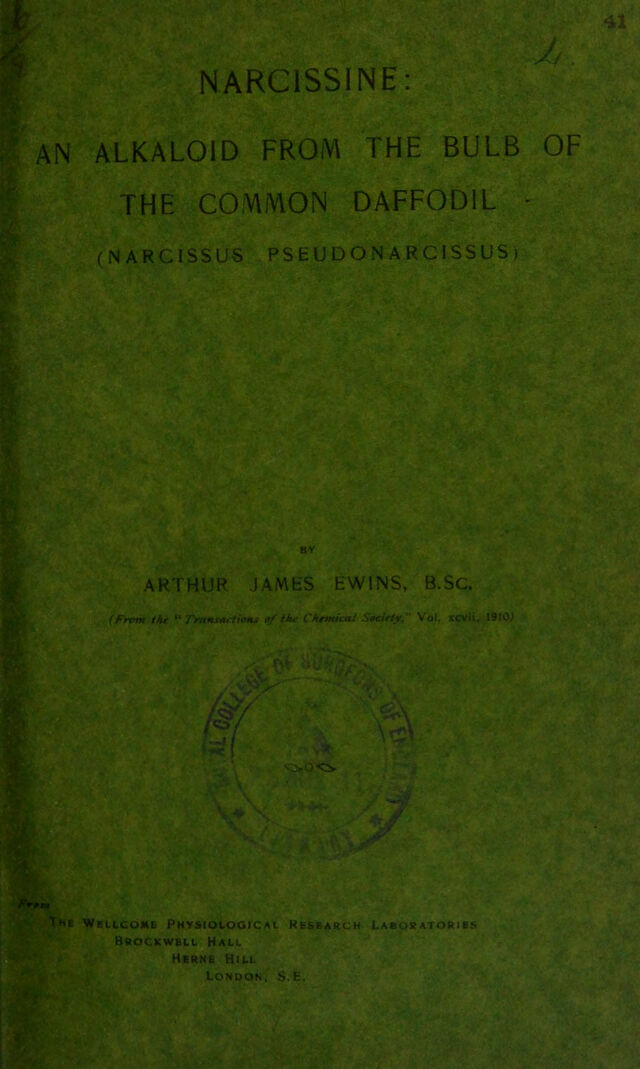
Narcissine : an alkaloid from the bulb of the common daffodil (Narcissus pseudonarcissus) / by Arthur James Ewins.
- Ewins, Arthur James.
- Date:
- 1910
Licence: Attribution 4.0 International (CC BY 4.0)
Credit: Narcissine : an alkaloid from the bulb of the common daffodil (Narcissus pseudonarcissus) / by Arthur James Ewins. Source: Wellcome Collection.
Provider: This material has been provided by The Royal College of Surgeons of England. The original may be consulted at The Royal College of Surgeons of England.
7/8
![and finally at 110°, no alteration in weight taking place under these varying conditions: 0-1448 gave 0-3552 CO., and 0’0754 H20. C = 6fi-9; H = 5'8. 0-1283 „ 0-3159 CO’2 „ 0'0684 H„0. C = 671; H = 5'9. 01051 „ 50 c.c. No (moist) at 135° and 732 mm. N = 54. CIfiH,704N requires C = 66'9; H = 5'9; N = 50 per cent. A determination of the molecular weight was made by Barger’s microscopic method (Trans., 1904, 86. 286) in glacial acetic acid. 0 060 Gram, in T197 grams of solvent, was intermediate between 019 mol. and 0 20 mol., whence MAV. = 267. C,cTI1704N requires M.W. = 287. Properties of Narcissine.—The alkaloid, as before stated, is obtained by recrystallisation from .alcohol in colourless prisms, which melt at 266—267° with some decomposition and formation of a red liquid. The crystals are insoluble in water or dilute sodium hydroxide, but readily soluble in dilute acid. The acid solution gives all the usual alkaloidal reactions, for example, with Meyer's reagent, with a solution of iodine in potassium iodide, and with phosphotungstic acid. The crystalline product is only very sparingly soluble in methyl alcohol, ethyl alcohol, ethyl acetate, or acetone, moderately so in pyridine, nitrobenzene, or glacial acetic acid, and insoluble in ether or chloroform. A determination of its solubility in absolute ethyl alcohol showed that one part by weight of the alkaloid was soluble in 284 parts of boiling alcohol and in 340 parts of alcohol at 15°. The alkaloid is kevorotatory. 0-166 Gram, made up to 100 c.c. with absolute alcohol, gave, in a 2'2-dcm. tube at 10°, an —035°, whence [a] j“ — 958°. The alkaloid dissolves in concentrated sulphuric acid, producing: a deep red solution, which slowly becomes reddish-brown on keeping. Narcissine Hydrochloride, ClcT:I1704N,IICl.—03 Gram of crude narcissine was dissolved in dilute hydrochloric acid, and the solution evaporated to dryness over potassium hydroxide in a desiccator. The resulting crystalline product was dissolved in hot 90 per cent, alcohol, and after treatment with a little blood-charcoal, the solu- tion, on cooling, deposited the hydrochloride in long, thin prisms, melting at 198—199°. Yield, 027 gram: 02737 gave 01176 AgCl. Cl = 106. C,gH1704N,HC1 requires 01 = 10 9 per cent. The 'Wellcome Physiological Research Laboratories, Herne Hill, S.E. R. Cl,AY AND SONS, LTD., r.ltfcAL* ST. HILL, R.C., AND BUNGAY, SUFFOLK.](https://iiif.wellcomecollection.org/image/b22432930_0008.jp2/full/800%2C/0/default.jpg)


 No text description is available for this image
 No text description is available for this image
 No text description is available for this image