The constitution of chrysophanic acid and of emodin / by H.A.D. Jowett and C.E. Potter.
- Jowett, Hooper Albert Dickinson, 1870-1936.
- Date:
- [1903]
Licence: In copyright
Credit: The constitution of chrysophanic acid and of emodin / by H.A.D. Jowett and C.E. Potter. Source: Wellcome Collection.
Provider: This material has been provided by The Royal College of Surgeons of England. The original may be consulted at The Royal College of Surgeons of England.
8/14 page 1330
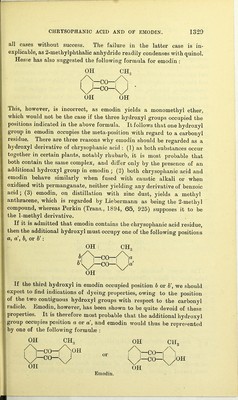
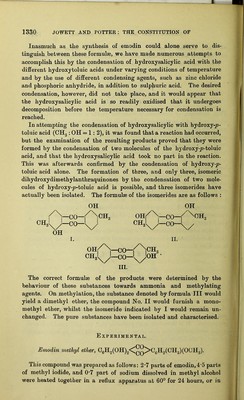
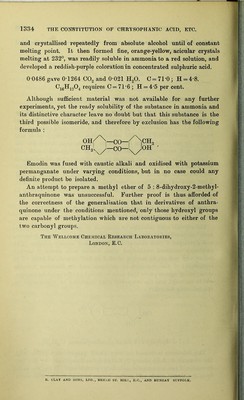
![Inasmuch as the synthesis of emodin could alone serve to dis- tinguish between these formulae, we have made numerous attempts to accomplish this by the condensation of hydroxysalicylic acid with the different hydroxytoluic acids under varying conditions of temperature and by the use of different condensing agents, such as zinc chloride and phosphoric anhydride, in addition to sulphuric acid. The desired condensation, however, did not take place, and it would appear that the hydroxysalicylic acid is so readily oxidised that it undergoes decomposition before the temperature necessary for condensation is reached. In attempting the condensation of hydroxysalicylic with hydroxy-jo- toluic acid (OH3 : OH = 1:2), it was found that a reaction had occurred, but the examination of the resulting products proved that they were formed by the condensation of two molecules of the hydroxy-js-toluic acid, and that the hydroxysalicylic acid took no part in the reaction. This was afterwards confirmed by the condensation of hydroxy-y>- toluic acid alone. The formation of three, and only three, isomeric dihydroxydimethylanthraquinones by the condensation of two mole- cules of hydroxy-jo-toluic acid is possible, and three isomerides have actually been isolated. The formulae of the isomerides are as follows : OH OH OH I. II. OHf/\-00-f/N]CH3 CH^-CO-^OH ’ III. The correct formulae of the products were determined by the behaviour of these substances towards ammonia and methylating agents. On methylation, the substance denoted by formula III would yield a dimethyl ether, the compound No. II would furnish a mono- methyl ether, whilst the isomeride indicated by I would remain un- changed. The pure substances have been isolated and characterised. Experimental. Emodin methyl ether, 06H2(OH)2<^>C6H2(CH3)(OOH3). This compound was prepared as follows: 2*7 parts of emodin, 4'5 parts of methyl iodide, and 0‘7 part of sodium dissolved in methyl alcohol were heated together in a reflux apparatus at 60° for 24 hours, or in](https://iiif.wellcomecollection.org/image/b22401830_0010.jp2/full/800%2C/0/default.jpg)

 No text description is available for this image
 No text description is available for this image
 No text description is available for this image