Clinical chemistry : an account of the analysis of blood, urine, morbid products, etc., with an explanation of some of the chemical changes that occur in the body, in disease / by Charles Henry Ralfe.
- Ralfe C. H. (Charles Henry), 1842-1896.
- Date:
- 1883
Licence: Public Domain Mark
Credit: Clinical chemistry : an account of the analysis of blood, urine, morbid products, etc., with an explanation of some of the chemical changes that occur in the body, in disease / by Charles Henry Ralfe. Source: Wellcome Collection.
Provider: This material has been provided by the Royal College of Physicians of Edinburgh. The original may be consulted at the Royal College of Physicians of Edinburgh.
18/330 page 4
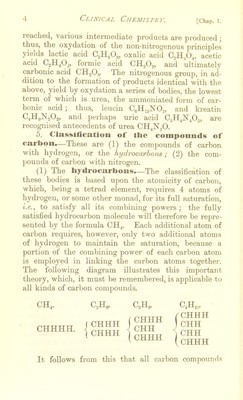
![reached, various intermediate products are produced; thus, the oxydation of the non-nitrogenous principles yields lactic acid 03H6Os, oxalic acid C2H204, acetic acid C2H402, formic acid CH202, and ultimately carbonic acid CH-A- The nitrogenous group, in ad- dition to the formation of products identical with the above, yield by oxydation a series of bodies, the lowest term of which is urea, the ammoniated form of car- bonic acid; thus, leucin C6HiaISr02, and kreatin C4H9NS02, and perhaps uric acid C5H4]Sr4Oa, are recognised antecedents of urea CH4N20. 5. Classification of the compounds of carbon.—These are (1) the compounds of carbon with hydrogen, or the hydrocarbons; (2) the com- pounds of carbon with nitrogen. (1) The hydrocarbons—The classification of these bodies is based upon the atomicity of carbon, which, being a tetrad element, requires 4 atoms of hydrogen, or some other monad, for its full saturation, i.e., to satisfy all its combining powers; the fully satisfied hydrocarbon molecule will therefore be repre- sented by the formula CH4. Each additional atom of carbon requires, however, only two additional atoms of hydrogen to maintain the saturation, because a portion of the combining power of each carbon atom is employed in linking the carbon atoms together. The following diagram illustrates this important theory, which, it must be remembered, is applicable to all kinds of carbon compounds. CH4. C2H, CSH. C4H: It follows from this that all carbon compounds](https://iiif.wellcomecollection.org/image/b21699513_0018.jp2/full/800%2C/0/default.jpg)