Clinical chemistry : an account of the analysis of blood, urine, morbid products, etc., with an explanation of some of the chemical changes that occur in the body, in disease / by Charles Henry Ralfe.
- Ralfe C. H. (Charles Henry), 1842-1896.
- Date:
- 1883
Licence: Public Domain Mark
Credit: Clinical chemistry : an account of the analysis of blood, urine, morbid products, etc., with an explanation of some of the chemical changes that occur in the body, in disease / by Charles Henry Ralfe. Source: Wellcome Collection.
Provider: This material has been provided by the Royal College of Physicians of Edinburgh. The original may be consulted at the Royal College of Physicians of Edinburgh.
26/330 page 12
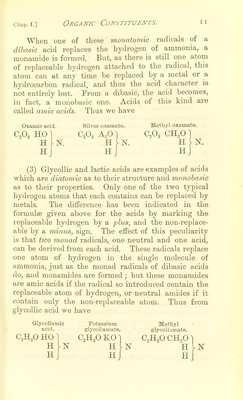
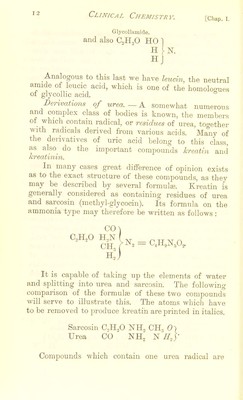
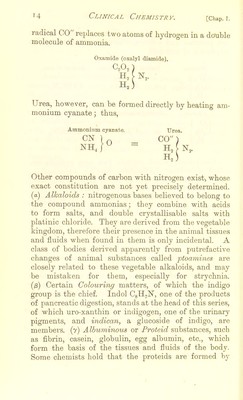
![GlycollamicTe. and also C2H„0 HO ] H f N. HJ Analogous to this last we have leucin, the neutral amide of leucic acid, which is one of the homoWues of glycollic acid. Derivations of urea. — A somewhat numerous and complex class of bodies is known, the members of which contain radical, or residues of urea, together with radicals derived from various acids. Many of the derivatives of uric acid belong to this class, as also do the important compounds kreatin and kreatinin. In many cases great difference of opinion exists as to the exact structure of these compounds, as they may be described by several formulae. Kreatin is generally considered as containing residues of urea and sarcosin (methyl-glycocin). Its formula on the ammonia type may therefore be written as follows : GO\ a,H20 H,N ( w r,TTATn CH, = C4H9N,02. H2) It is capable of taking up the elements of water and splitting into urea and sarcosin. The following comparison of the formulae of these two compounds will serve to illustrate this. The atoms which have to be removed to produce kreatin are printed in italics. Sarcosin CH.,0 NH, CH3 0\ Urea CO NEL N II,y Compounds which contain one urea radical are](https://iiif.wellcomecollection.org/image/b21699513_0026.jp2/full/800%2C/0/default.jpg)