Clinical chemistry : an account of the analysis of blood, urine, morbid products, etc., with an explanation of some of the chemical changes that occur in the body, in disease / by Charles Henry Ralfe.
- Ralfe C. H. (Charles Henry), 1842-1896.
- Date:
- 1883
Licence: Public Domain Mark
Credit: Clinical chemistry : an account of the analysis of blood, urine, morbid products, etc., with an explanation of some of the chemical changes that occur in the body, in disease / by Charles Henry Ralfe. Source: Wellcome Collection.
Provider: This material has been provided by the Royal College of Physicians of Edinburgh. The original may be consulted at the Royal College of Physicians of Edinburgh.
29/330 page 15
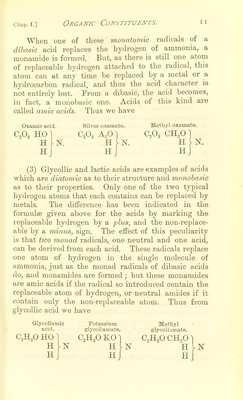
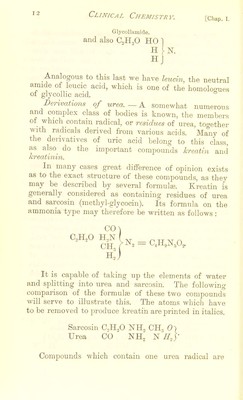
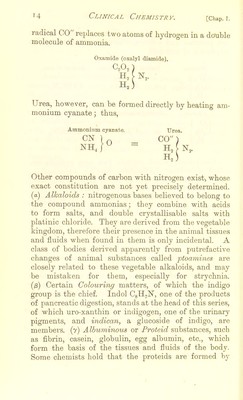
![chap, i.] Organic Constituents. <5 the combination of an azotised principle, of a dibasic acid character, with different saline bases in varying proportions. Others, that these substances contain a radical called protein, combined with more or less hydrogen, sulphur, and phosphorus, according to the nature of the substance. 6. Synthesis and analysis.—For many years it was supposed that organic substances could be formed only by the agency of a living organism. In 1828, however, Wohler obtained urea by evaporating ammonium cyanate, and since that time chemists have obtained by artificial means a large number of compounds formerly obtainable only from animal or vegetable organisms. These syntheses are effected either by bringing together molecules of simpler constitution to form a more complex body, as in the case of hippuric acid ; Glycocin. Benzoio acid. Hippuric acid. C2Hs0H2NH0 + C7H50 HO = CaH30 H(C7H50)N HO + H20. or by building up an organic compound from purely inorganic sources ; as Berthelot obtained formic acid by heating carbon monoxide with potassium hydrate at 100° C. Carbon monoxide. Potassium hydrate. Potassium formate. CO + HKO = °H^}0 or, as Kolbe formed acetic acid from carbon di- sulphide. In nature this formation of organic compounds from inorganic materials (synthesis) is effected by the agency of the vegetable kingdom. The plant under the influence of the' rays of the sun liberates a quantity of oxygen from inorganic constituents such as carbonic acid, water, and ammonium carbonate,](https://iiif.wellcomecollection.org/image/b21699513_0029.jp2/full/800%2C/0/default.jpg)