Clinical chemistry : an account of the analysis of blood, urine, morbid products, etc., with an explanation of some of the chemical changes that occur in the body, in disease / by Charles Henry Ralfe.
- Ralfe C. H. (Charles Henry), 1842-1896.
- Date:
- 1883
Licence: Public Domain Mark
Credit: Clinical chemistry : an account of the analysis of blood, urine, morbid products, etc., with an explanation of some of the chemical changes that occur in the body, in disease / by Charles Henry Ralfe. Source: Wellcome Collection.
Provider: This material has been provided by the Royal College of Physicians of Edinburgh. The original may be consulted at the Royal College of Physicians of Edinburgh.
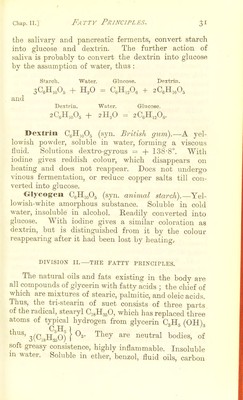
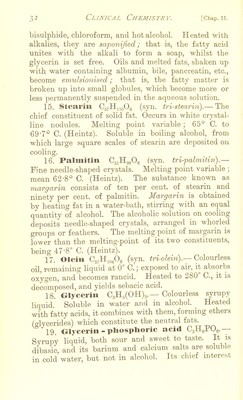
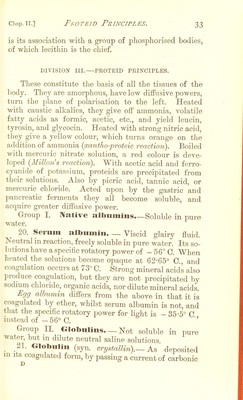
44/330 page 30
![and ether, unfermentable with yeast, no action on polarised light; alkaline solutions do not reduce salts of copper, but give a greenish tint which clears up on standing, leaving original blue solution, but which again becomes green on heating. Heated to dryness on platinum foil, with a drop of nitric acid, the residue moistened with ammonia and calcium chloride yields a beautiful rose colour. Group II. Saccharoses n(C12H22Ou). 13. Saccharose ClsHMOu (syn. cane sugar).— Crystals, monoclinic prisms, very soluble in water, insoluble in absolute alcohol and water. Solutions have a dextro-rotatory power + 73 8°. Boiled with water for some hours it is converted into a mixture of glucose and lsevulose, or invert sugar. It ferments with yeast, but is transformed first into glucose. Does not at first reduce cupric salts from alkaline solutions, but does so after a while. In the intestines cane sugar is converted into invert sugar. Lactose C]2rl>20,] + H20 (syn. milk sugar).— Crystals rhombic, soluble in six parts of cold water; dextro-rotatory power = +59-3°. Does not readily tmdergo vinous fermentation; reduces copper in alkaline solutions. Boiled for some hours with dilute acids, forms galactose, this treated with nitric acid yields mucic acid. Group III. Amyloses n(C6H10O5). 14. Amylum C6H10O5 (syn. starch).—Granules, rounded, irregular form, marked with concentric laminse, having a hilum or pore on surface. Insoluble in cold water, but when boiled swell up, burst, and form paste or mucilage. Solution is dextro-gyrous + 216°. With iodine, starch solutions give a deep blue colour, which it loses when heated to 100° C, but regains it on cooling. Diastase, dilute sulphuric acid.](https://iiif.wellcomecollection.org/image/b21699513_0044.jp2/full/800%2C/0/default.jpg)