Licence: Public Domain Mark
Credit: Outlines of human osteology / by F.O. Ward. Source: Wellcome Collection.
334/392 page 314
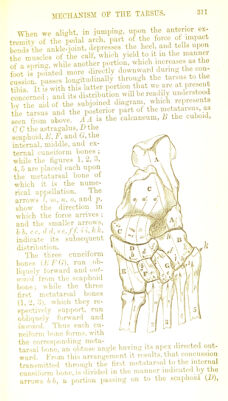
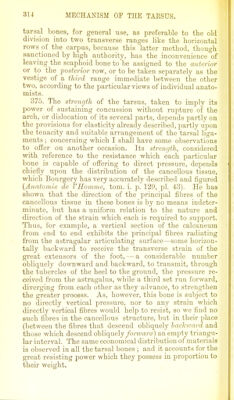
![tarsal bones, for general use, as preferable to the old diNdsion into two transverse ranges like the horizontal rows of the carpus, because this latter method, though sanctioned bj' high authority, has the inconvenience of leaving the scajDhoid bone to be assigned to the anterior or to the posterior row, or to be taken separately as the vestige of a third range immediate between the other two, according to the particular views of individual anato- mists. 375. The strength of the tarsus, taken to imply its l^ower of sustaining concussion without ruiDture of the arch, or dislocation of its several parts, depends partly on the provisions for elasticity already described, partly upon the tenacity and suitable arrangement of the tarsal liga- ments ; concerning which I shall have some observations to offer on another occasion. Its strength, considered with reference to the resistance which each particular bone is capable of offering to direct pressure, dejDeuds chiefly upon the distribution of the cancellous tissue, which Bourgery has very accurately described and figured (Anatomie de I'Homme, tom. i. p. 129, pi. 43). He has shown that the direction of the principal fibres of the cancellous tissue in these bones is by no means indeter- minate, but has a uniform relation to the nature and direction of the strain which each is required to support. Thus, for example, a vertical section of the calcaneum from end to end exhibits the princi]5al fibres radiating from the astragalar articulating surface—some horizon- tally backward to receive the transverse strain of the great extensors of the foot, — a considerable number obliquely downward and backward, to transmit, through the tubercles of the heel to the ground, the jDressure re- ceived from the astragalus, while a third set run forward, diverging from each other as they advance, to strengthen the greater process. As, however, this bone is subject to no directly vertical pressure, nor to any strain which directly vertical fibres would help to resist, so we find no such fibres in the cancellous structure, but in their place (between the fibres that descend obliquely haclnrard and those which descend obliquely fnnvara) an empty triangu- lar interval. The same economical distribution of materials is observed in all the tarsal bones ; and it accounts for the great resisting power which they possess in proportion to their weight.](https://iiif.wellcomecollection.org/image/b20410918_0352.jp2/full/800%2C/0/default.jpg)
 No text description is available for this image
 No text description is available for this image
 No text description is available for this image