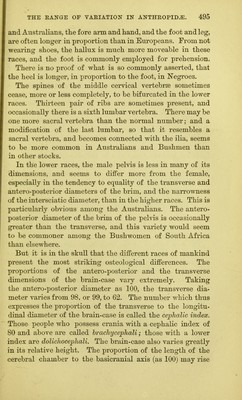
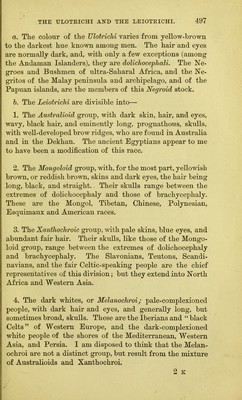
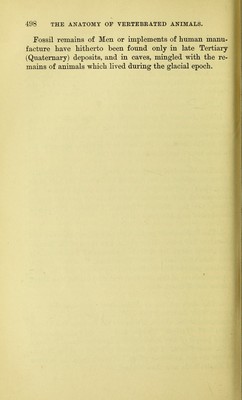
A manual of the anatomy of vertebrated animals / by Thomas H. Huxley.
- Thomas Henry Huxley
- Date:
- 1871
Licence: Public Domain Mark
Credit: A manual of the anatomy of vertebrated animals / by Thomas H. Huxley. Source: Wellcome Collection.
Provider: This material has been provided by King’s College London. The original may be consulted at King’s College London.
506/528 page 494
![smaller than the male. These differences become more marked at, and subsequent to, puberty; and are seen in the smaller stature of the female, the larger size of the head j in proportion to the stature, the shorter thorax, the longer abdomen, and the shorter legs ; so that the middle point of the stature of the female is nearer the umbilicus than in the male. The hips are wider in proportion to the shoul- ders, whence the femora are more oblique. The ridges and muscular processes of all the bones are less marked, and the frontal contour of the skull is more sharply angulated. When the peculiarities of the female sex are not connected with reproduction, they may be said to be infantile. The different persistent modifications or “ races ” of man- kind present a very considerable amount of variation in their anatomical characteristics. The colour of the skin varies ] from a very pale reddish brown—of the so-called “ white ” races—through all shades of yellow and red browns, to olive and chocolate, which may be so dark as to ]ook black. The hair differs much in its character, having sometimes j a circular, sometimes an oval or flattened transverse section, j and presenting all varieties, from extreme length and : straightness to short, crisp wool. The hair on the scalp is longer than that elsewhere; and it is very often, but not always, longer in the female. Hair upon the face and body is scanty in most races, and almost absent, except in the eyebrows, in some; but in others it becomes greatly developed over the lips, chin, and sides of the face, on the thorax, abdomen, and pubes, in the axillae, and sometimes, though more rarely, upon the rest of the body and limbs. When hair is developed upon the limbs the points of the hairs of the arm and fore arm slope | towards the elbow, and those of the leg and thigh away from the knee, as in the Anthropomorpha. Enormous accumulations of fat take place upon the but- j tocks of the Bosjesmen, especially in the females; and the nymphse of these and some other Negroid tribes become greatly elongated. It appears that in some of the lower races, e.g., Negroes](https://iiif.wellcomecollection.org/image/b21302728_0506.jp2/full/800%2C/0/default.jpg)