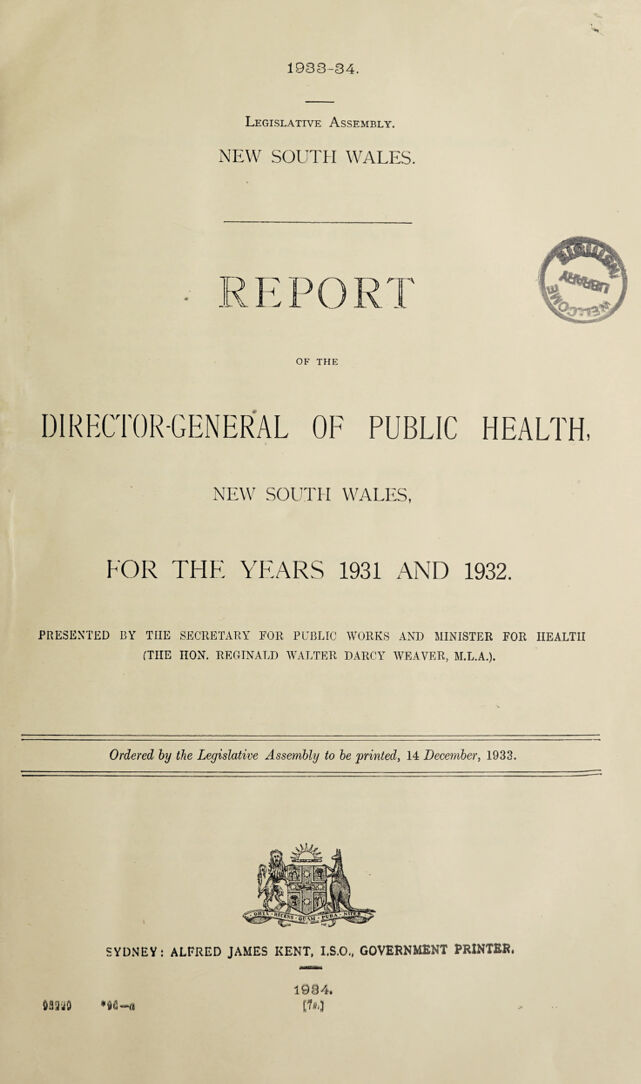
Report of the Director-General of Public Health, New South Wales.
- New South Wales. Department of Public Health
- Date:
- [1932]
Licence: Public Domain Mark
Credit: Report of the Director-General of Public Health, New South Wales. Source: Wellcome Collection.
38/174 page 20
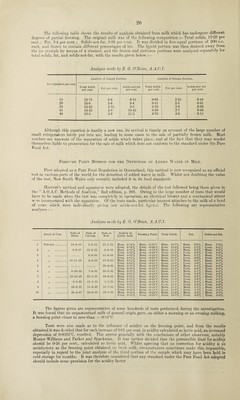
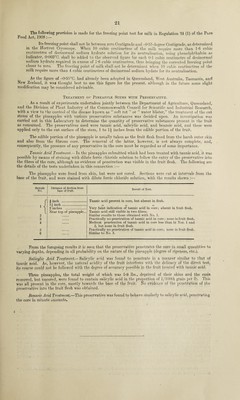
![The following table shows the results of analysis obtained from milk which has undergone different degrees of partial freezing. The original milk was of the following composition Total solids, 12*28 per cent.; Fat, 3*4 per cent.; Solids-not-fat, 8-88 per cent. It was divided in five equal portions of 200 c.c. each, and frozen to contain different percentages of ice. The liquid portion was then drained away from the ice crystals by means of a strainer, and the frozen and unfrozen portions were analysed separately for total solids, fat, and solids-not-fat, with the results given below - Analyses made by E. G. O'Brien, A.A.0.1. Ice separated per cent. Analysis of Liquid Portion. Analysis of Frozen Portion. Total Solids per cent. Eat per cent. Solids-not-fat per cent. Total Solids per cent. Eat per cent. Solids-not, fat per cent. 15 12-75 3-6 9-15 9-03 2-55 6-48 20 13-0 3-6 9-4 9-11 2-5 6-61 24 13-25 3-75 9-5 9-26 2-6 6-66 41 14-45 4-0 10-45 9-38 2-7 6-68 49 15-5 4-2 113 8-75 2-6 6-15 Although this question is hardly a new one, its revival is timely on account of the large number of small refrigerators lately put into use, leading in some cases to the sale of partially frozen milk. Most vendors are unaware of the separation of solids which takes place, and of the fact that they may render themselves liable to prosecution for the sale of milk which does not conform to the standard under the Pure Food Act. Freezing Point Method for the Detection of Added Water in Milk. First adopted as a Pure Food Regulation in Queensland, this method is now recognised as an official test in various' parts of the world for the detection of added water in milk. Whilst not doubting the value of the test, Mew South Wales only recently included it in its food standards. Hortvet’s method and apparatus were adopted, the details of the test followed being those given in the “ A.O.A.C. Methods of Analysis,” 2nd edition, p. 265. Owing to the large number of tests that would have to be made when the test was completely in operation, an electrical blower and a mechanical stirrer wu’o incorporated with the apparatus. Of the tests made, particular interest attaches to the milk of a herd of cows which were individually giving low solids-not-fat figures. The following are representative analyses :— Analyses made by E. G. O'Brien, A.A.C.I. Breed of Cow. Date of Birth. Date of | Calving. 1 Date ot Test. Acidity as Lactic Acid. Freeaing Point. Total Solids. l Friesian . 18-9-16 2-2-31 1 1 L cq Morn. 0-14% Morn. -0-56°C Morn. 10-7% Even. 0-14% Even. -0-56°C. Even. 12-2% 2 .. 5-8-27 12-2-31 8-6-31 Morn. 0-12% Morn. -0-55°C. Morn. 11-4% Even. 0-12% Even. -0-54°C. Even. 12-5% 3 5-3-31 11-6-31 Morn. ()•] 5% Morn. —0*54°C. Morn. 10-2% Even. 0-15% Even. -054°C. Even. 12-3% 4 10-11-28 2-4-31 17-6-31 Morn. 0-14% Morn. -0-54°0. Morn. 11-7% Even. 0-14% Even. -0-55°C. Even. 12-5% 5 22-6-31 Morn. 0-13% Morn. — 0*54°C. Morn. 11-4% Even. 0-14% Even. -0-55°C. Even. 12-3% 0 4-10-28 7-4-31 28-6-31 Morn. 0-13% Morn. -0-54°C. Morn. 11-3% Even. 0-14% Even. -0-54°C. Even. 12-2% 7 12-12-28 23-3-31 29-6-31 Morn. 012% Morn. -0-55°C. Morn. 10-8% Even. 0-13% Even. -055°C. Even. 11-5% 8 3-6-21 18-4-31 1-7-31 Morn. 0-12% Morn. -0-54°C. Morn. 11-2% Liven. 0-12% Even. -0-54°C. Even. 13-2% 9 26-4-21 11-4-31 12-7-31 Morn. 0-13% Morn. -0-54°C. Morn. 11-5% Even. 0-13% Even. -C-54°C. Even. 11-8% 10 21-4-27 25-3-31 13-7-31 Morn. 0-14% Morn. -0-54°C. Morn. 11-0% Even. 0-14% Even. -0-55°C. Even. 13-7% Eat. Morn. 2-8% Even. 3-7% Morn. 3-2% Even. 3-9% Morn. 2-7% Even. 4-0% Morn. 3-2% Even. 3-8% Morn. 3-4% Even. 4-0% Morn. 3-1% Even. 3-6% Morn. 2-9% Even. 3-4% Morn. 2-9% Even. 5-0% Morn. 3-5% Even. 3-6% Morn. 2-5% Even. 4-8% Solids-not-fat. Morn. 7'9% Even. 8-5% Mom. 8-2% Even. 8-6% Morn. 7-5% Even. 8-3% Morn. 8-5% Even. 8-7% Morn. 8-0% Even. 8-3% Morn. 8-2% Even. 8-0% Morn. 7-9% Even. 8-1% Morn. 8-3% Even. 8-2% Morn. 8-0% Even. 8-2% Morn. 8-5% Even. 8-9% The figures given are representative of some hundreds of tests performed during the investigation. It was found that no unpasteurised milk of general origin gave, on either a morning or an evening milking, a freezing point closer to zero than — 0*54°C. Tests were also made as to the influence of acidity on the freezing point, and from the results obtained it was d< cided that for each increase of 0*01 per cent, in acidity calculated as lactic acid, an increased depression of 0*0033°C. resulted. This agrees generally with the conclusions of other observers, notably Monier-Williams and Parker and Spackman. It was further decided that the permissible limit for acidity should be 0*36 per cent., calculated as lactic acid. Whilst agreeing that no correction for acidity is as satisfactory as the freezing point obtained on fresh milk, circumstances sometimes make this impossible, especially in regard to the joint analysis of the third portion of the sample which may have been held in cold storage for months. It was therefore considered that any standard under the Pure Food Act adopted should include some provision for the acidity factor](https://iiif.wellcomecollection.org/image/b31485236_0038.jp2/full/800%2C/0/default.jpg)