Experiments on the isolated mammalian heart to show the relation of the inorganic salts to the action of the accelerator and inhibitory nerves / by W.H. Howell and W.W. Duke.
- William Henry Howell
- Date:
- [1906?]
Licence: Public Domain Mark
Credit: Experiments on the isolated mammalian heart to show the relation of the inorganic salts to the action of the accelerator and inhibitory nerves / by W.H. Howell and W.W. Duke. Source: Wellcome Collection.
5/28
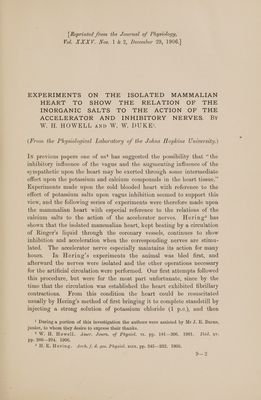
![[Reprinted from the Journal of Physiology, Vol. XXXV. Nos. 1 & 2, December 29, 1906.] EXPERIMENTS ON THE ISOLATED MAMMALIAN HEART TO SHOW THE RELATION OF THE INORGANIC SALTS TO THE ACTION OF THE ACCELERATOR AND INHIBITORY NERVES. By W. H. HOWELL anv W. W. DUKE? (From the Physiological Laboratory of the Johns Hopkins University.) IN previous papers one of us? has suggested the possibility that “the inhibitory influence of the vagus and the augmenting influence of the sympathetic upon the heart may be exerted through some intermediate effect upon the potassium and calcium compounds in the heart tissue.” Experiments made upon the cold blooded heart with reference to the effect of potassium salts upon vagus inhibition seemed to support this view, and the following series of experiments were therefore made upon the mammalian heart with especial reference to the relations of the calcium salts to the action of the accelerator nerves. Hering® has shown that the isolated mammalian heart, kept beating by a circulation of Ringer's liquid through the coronary vessels, continues to show inhibition and acceleration when the corresponding nerves are stimu- lated. The accelerator nerve especially maintains its action for many hours. In Hering’s experiments the animal was bled first, and afterward the nerves were isolated and the other operations necessary for the artificial circulation were performed. Our first attempts followed this procedure, but were for the most part unfortunate, since by the time that the circulation was established the heart exhibited fibrillary contractions. From this condition the heart could be resuscitated usually by Hering’s method of first bringing it to complete standstill by injecting a strong solution of potassium chloride (1 p.c.), and then 1 During a portion of this investigation the authors were assisted by Mr J. E. Burns, junior, to whom they desire to express their thanks. 2 W. H. Howell. Amer. Journ. of Physiol. v1. pp. 181—206. 1901. Ibid. xv. pp. 280—294. 1906. 3H. E. Hering. Arch. f. d. ges. Physiol. xcrx. pp. 245—252. 1903. 9—2](https://iiif.wellcomecollection.org/image/b33441108_0005.jp2/full/800%2C/0/default.jpg)