Elements of medical jurisprudence / By Theodric Romeyn Beck and John B. Beck.
- Theodric Romeyn Beck
- Date:
- 1836
Licence: Public Domain Mark
Credit: Elements of medical jurisprudence / By Theodric Romeyn Beck and John B. Beck. Source: Wellcome Collection.
946/1024 page 938
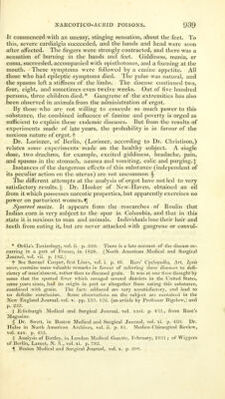
![Braconnot and Letellier have analyzed poisonous mushrooms. The latter discovered in one of them a principle which he called amanetin, and which appears to be highly deleterious. * Treatment. Mushrooms are best combated by emetics, cathartics, and particularly enemas. Secale cornutvm. (Ergot, spurred rye.) There is some diversity of opinion concerning the real nature of this substance. By some, it is supposed to be a diseased process from the juices of the plant. De- candolle, on the other hand, states, that it is caused by the growth of a parasitic plant, a mushroom of the genus sclerotium; while, proba- bly, the most numerous party assert that it is the work of an insect. General Field, of Vermont, stated, that he had observed flies punctur- ing the glumes of the rye during its milky state ; and imitating this process himself with a needle, found that in four days a little black point appeared, which gradually became a spur, f Whatever the cause may be, it is certain that this substance, either alone, or contaminating rye, has long been deemed a poison. It is thus stated to have given rise to epidemic diseases at various times, in France, Silesia, Prussia, Bohemia, Saxony, and Sweden. Perrault mentions, that in travelling through Sologne, in France, he was in- formed by some physicians and surgeons of that country, that the rye there was sometimes so corrupted, that those who ate bread made of it were seized with a gangrene, some in one part and some in another; some losing a finger, others a hand or the nose ; and that this gan- grene was not preceded by any fever, inflammation, or considerable pain, but that the parts fell off of themselves : the early symptoms were numbness, cold, and livid skin, pain, and swelling. J Tissot, in a paper in the Philosophical Transactions, presents a very copious account of the disease in question, and divides it into two forms, the spasmodic and gangrenous. He observes, that the first accurate account of it was published in 1596. The spasmodic disease prevailed, according to Hoffman, in 1648, 164-9, and 1675, in Voigt- land ; in 1702, in Friburg ; in 1760, in Saxony and Lusatia, and in 1722 in Silesia. It was frequently attended with epilepsy. The gan- grenous form was known in France as early as 1030, and in 1650, 1670, and 1674, it raged in Aquitaine and Sologne. In 1709 it ap- peared in Switzerland. The symptoms were similar to those already noticed. It attacked persons of both sexes and all ages, and in some instances only the lower extremities became gangrenous, while in others, both upper and lower were affected, § Mr. Srine has described its effects as occurring, in 1736, in Bohemia. * Vauquelin's experiments on mushrooms may be found in the Philosophical Ma- gazine, vol. xliii. p. '292. + See on this subject, Brande's Journal, vol. ii. pp. 273. 320.; vol. iii. p. 429. Dr. Tully, who supports (lie opinion of* Decandolle, in Silliman's Journal, vol. ii. p. 45. Gen. Field, in ibid. vol. ix. p. 359. Christison, p. 78f3. Burnett (Outlines of Botany, vol. i. p. 206.) says (hat (he mushroom is not a Sclerotium, but Achiula clavus. j Philosophical Transactions, vol. xi. p. 758.; see also vol. Hi. p. 529-, where cases are re^:'to^ that occurred at Orleans and Blois. e Philosophical Transaction.-., vol. lv. p. ]06.](https://iiif.wellcomecollection.org/image/b2044347x_0948.jp2/full/800%2C/0/default.jpg)
 No text description is available for this image
 No text description is available for this image
 No text description is available for this image