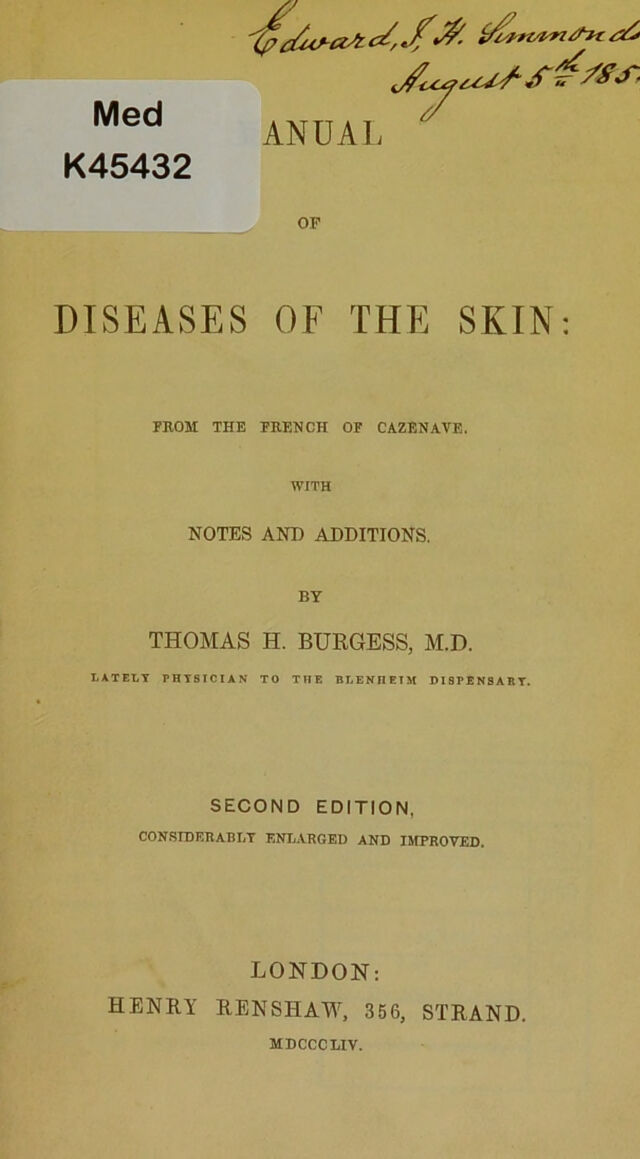
Manual of diseases of the skin / from the French of Cazenave ; with notes and additions by Thomas H. Burgess.
- Pierre Louis Alphée Cazenave
- Date:
- 1854
Licence: Public Domain Mark
Credit: Manual of diseases of the skin / from the French of Cazenave ; with notes and additions by Thomas H. Burgess. Source: Wellcome Collection.
12/446 page 2
![large expansions of mucous membrane, in the interior of tlie body, apart from tlie true glands and the skin, which form with them a great System.—B.] There are no diseases which bave been, and are still. so much neglected as diseases of the skin ; yet there are none so easily recog- nised, for their oharacteristic phenomena are appréciable by the eye, while they are at the same time extremelv frequent. Perhaps, however, these two circumstances may aceount for the confusion wliich has prevailed in the liistory of cutaneous aifections ; here, as in many other branches of medicine, the multitude of facts has rnerely served to encumber the science, without enriching it; and what other results could we expect, when the different stages of the same affection hâve been described as diseases essentially different from each other, and the various facts on wliich the science rests hâve been collected without order or any view to classification. A variety of generic ternis hâve been employed by the French pathologists, from time to time, to designate cutaneous diseases : as for instance, Leprosy, Herpetic éruption, Dartre. The term dartre (from Saproç, excoriated) was long a favourite one, and îs still vulgarly applied to a certain class of skin diseases ; but we are of opinion that it shoiüd be rejected, as a term of too uncertam signification to be employed in medical language. In tliis respect we bave followed the example of Englisk writers, who bave ceased to employ the terms “scurvy and leprosy,” corresponding to our words “dartre and leprosy.” . The ancients were acquainted with diseases of the skin, winch seem to bave been very frequent amongst the Egyptians. The first express mention that we find of them is contained in the bock ot Leviticus, where Moses commanda that ail persons affected with tsaraàth be separated from the rest of the people; he descnbes, at the same time, the symptoms by which tliis disease may berecog- nised. AccorcUng to Herodotus, who lived 1000 years after Moses, the laws of the Jews respecting leprosy were derived from the expérience of the Egyptians. The Septuagint translation of the He- brew word nrtt (Isaraath) is Xiirpa, which latter, no doubt, was m- tended to express some severe cutaneous disease. But tlie symptoms of Xkirpa, according to the Greek physicians, are quite different](https://iiif.wellcomecollection.org/image/b28049573_0012.jp2/full/800%2C/0/default.jpg)


 No text description is available for this image
 No text description is available for this image
 No text description is available for this image