Nereis Britannica; continens species omnes fucorum in Insulis Britannicis crescentium ... - Nereis Britannica; containing all the species of fuci, natives of the British coasts: with a description in English and Latin. And plates coloured from nature / By John Stackhouse.
- John Stackhouse
- Date:
- 1801
Licence: Public Domain Mark
Credit: Nereis Britannica; continens species omnes fucorum in Insulis Britannicis crescentium ... - Nereis Britannica; containing all the species of fuci, natives of the British coasts: with a description in English and Latin. And plates coloured from nature / By John Stackhouse. Source: Wellcome Collection.
45/210 page 35
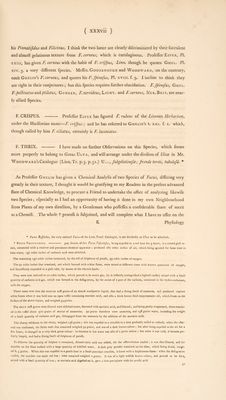
![( iexxw ) F. ACULEATUS. ———- The reprefentation of this Species in Esper’s Iconzs does not refemble the habit of the growing plant. Few Specimens preferve their Bafe ; In the Collection of Cor. VrLLrv I noticed two perfect Plants: the bafe was very fmall in proportion to the Stem. F.SACCHARINUS. —--— Attending more minutely to the fructification of this Spe- cies, I found in the Winter months that conical Pafille, with a perforation at top, were vifible on many fpecimens. Some, which I gathered, February, 1799, had fhed their feeds, and the apertures had widened confiderably : the feeds, as fuppofed, were adhering to the outer coat of the Frond, but fo {mall as to be difcoverable only as duft, with high magnifying powers. * Profeffor Esper has figured this Species in two Plates, but they afford no Idea of our t: Gigan- tic Var. e, Pl. ix. On examining fome recent Plants, I difcovered that the thick welted part in the middle of the frond ferves the purpofe of, and may be confidered as, a midrib. It branches off on each fide 1n beautiful undulations, from the main ftem, like the veining of leaves, F. NODOSUS. -——— Profeffor Esper has delineated this Species in a characteriftic man- ner, though manifeflly from a dried fpecimen, not in fructification. This generally takes place late in the Autumn, or in the Winter months, and like thofe of £F. fliqguofus, when fully ripe, they drop off ; which is the reafon that they are rarely, if ever, found during the Summer Months. P.LOREUS. —-—— Theabove Author has given two Plates with reprefentations of parts of this Species; Pl. xix, part of the fummit ; Pl. xxxix, the Radices Calycares, as he calls them, or Peziza-/haped Bafes. He has collected a variety of Synonyms, but thofe referring to Ulva pruniformis {eem out of place, as appears by Gunner’s Defcrip. p.2. p. 89, and by Es- PERS Ic. p. 82. F. FILUM. | ———- There are fingular miftakes with refpect to this fpecies committed by Profeffor Esper. His Pl. x xi, which he calls F. fium, Linn, Syft. Nat. p.717, adding asa Sy- | ion the Lagerfiroem. Amen. Ac.259. n. 53—the Indian Grafs, which is now known to be an anima] Production, is in fact the reprefentation of a Chinefe Land Plant. On the contrary, his Pl. xxin which he calls F. tendo, Linn. is certainly F. filum, Linn. | His Plate reprefents feve- ral coming up from a common Bafe. In that refpect, as well as in fize, F. fium, Linn. differs from the Species delineated in this Work. F. TAMARISCIFOLIUS. —-— — Nothing has occurred in addition to the ample account given of this Species—the F. ericoides of Linn. Tr. For the miftakes concerning this Fucus, fee what has been obferved under I. felaginoides, p. xxvutt. * Probably every Specimen has not perforated Papille ; fome may produce their feeds imbedded in the outer fkin, and others in the mucus of the finuous furrows where Licurroor difcovered them. + A fpecimen of the largeft fize, and likewife a fructified fpecimen, are depofited in the Library of the Linnean Socizry. It is 6 feet F. OSMUN- long by 9 inches wide,](https://iiif.wellcomecollection.org/image/b33543197_0045.jp2/full/800%2C/0/default.jpg)
 No text description is available for this image
 No text description is available for this image
 No text description is available for this image