The Veddas / by C.G. Seligmann and Brenda Z. Seligmann ; with a chapter by C.S. Myers ; and an appendix by A. Mendis Gunasekara.
- Charles Gabriel Seligman
- Date:
- 1911
Licence: In copyright
Credit: The Veddas / by C.G. Seligmann and Brenda Z. Seligmann ; with a chapter by C.S. Myers ; and an appendix by A. Mendis Gunasekara. Source: Wellcome Collection.
622/640 page 452
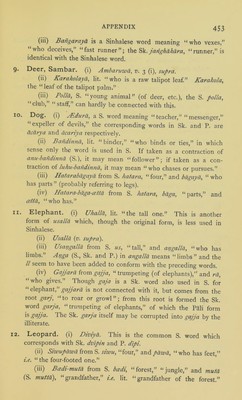
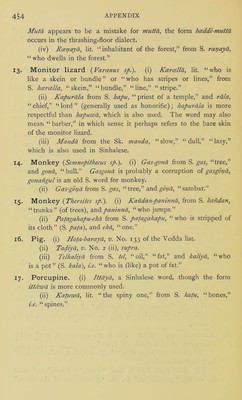
![3. Buffalo, (i) Ambarmva, lit. horn-bearer, from S. an, “horns,” and baruwd, “ who is laden ” or “ who bears ” (from Sk. Jbhri, to bear, to support); is changed into “w” before “6” which requires before it a nasal of the class to which it belongs. (ii) Gawaya, a Sinhalese word meaning “bull,” “ox,” “one of the ox kind,” corresponding with the Sk. gawa, go, cf. Sk. ga- wala, “wild buffalo.” (iii) Pimbinna is a Sinhalese word meaning “who snorts or makes a hissing sound with the nostrils ” (as when the animal is charging), from S. Jpimba, “ to blow.” . Civet cat. (i) Appala-boetceya appears to mean “one who moves skilfully among branches,” from S. appala (atpaia), “on branches,” and bcetceya (bcetaya, bataya), “ soldier,” “ one skilful in action.” (ii) Hotcembiliya is probably a variant of hotambaya (v. infra); hotcembiliya literally means “he whose ears are red,” from S. ho, “ ears,” and toembiliya, “ one like a king-cocoanut,” i.e. “ one who is red.” (iii) Hotambaya from ho, “ears,” and tambaya, “copper- coloured one,” i.e. “ one whose ears are copper-coloured.” 5. Cobra. Boyi-sattaya, lit. “the animal with a hood,” from boyi, “hood” (expanded), and sattaya, “animal”; boyi is a corrupt form of S. boya (Sk. bhoga), “(expanded) hood,” “coil,” “snake,” and sattaya is a corrupt form of the Sk. satvaya (with S. nom. sing, ending) used by illiterate Sinhalese, “being,” “animal.” 6. Crocodile. Gamaya, v. No. 2 (v), supra. 7. Deer, Axis, (i) Ambaruwa, v. No. 3 (i), supra. (ii) Pit-pcElcElla, this expression may mean “ who is a yellow bag,” from pit (Sk. pita), “yellow,” and poelalld (threshing-floor dialect), “bag.” Perhaps poelalld is a corruption of S. polla, “young animal,” while pit may be a mistake for, or a corruption of, S. tik, “ spots.” The spotted deer is called tik-muwa in Sin- halese, in which language pit also means “ bile,” “ bilious.” 8. Deer, Mouse, (i) Kekkd, lit. “who makes the cry of kek”; in Sinhalese the cry of the peacock is called kekd (Sk. heka). (ii) Yakadaya, lit. “who is like iron,” “who is stern,” from S. yakada, “iron.” [Mr Parker suggests that this expression is satirical and refers to the fragile appearance of the animal.]](https://iiif.wellcomecollection.org/image/b24851474_0622.jp2/full/800%2C/0/default.jpg)
 No text description is available for this image
 No text description is available for this image
 No text description is available for this image