On recent researches upon nitrous oxide narcosis : and their bearing upon the practical question, when and how should laughing gas be administered? : read at the Annual General Meeting of the British Dental Association at Brighton, August, 1889 / by Dudley Wilmot Buxton.
- Buxton, Dudley Wilmot, 1855-1931.
- Date:
- 1889
Licence: Public Domain Mark
Credit: On recent researches upon nitrous oxide narcosis : and their bearing upon the practical question, when and how should laughing gas be administered? : read at the Annual General Meeting of the British Dental Association at Brighton, August, 1889 / by Dudley Wilmot Buxton. Source: Wellcome Collection.
Provider: This material has been provided by The Royal College of Surgeons of England. The original may be consulted at The Royal College of Surgeons of England.
9/18 page 7
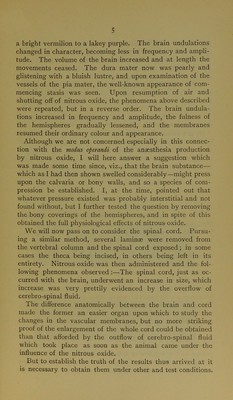
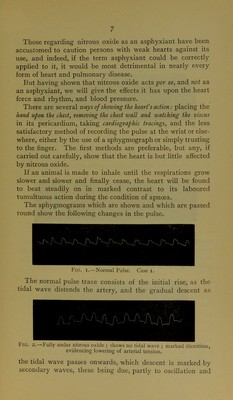
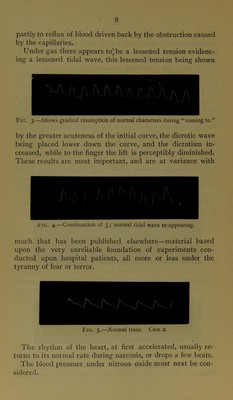
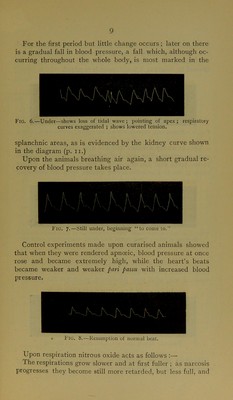
![Those regarding nitrous oxide as an asphyxiant have been accustomed to caution persons with weak hearts against its use, and indeed, if the term asphyxiant could be correctly applied to it, it would be most detrimental in nearly every form of heart and pulmonary disease. But having shown that nitrous oxide acts per se, and not as an asphyxiant, we will give the effects it has upon the heart force and rhythm, and blood pressure. There are several ways of showing the heart's action: placing the hand upon the chest, removing the chest wall and watching the viscus in its pericardium, taking cardiographic tracings, and the less satisfactory method of recording the pulse at the wrist or else- where, either by the use of a sphygmograph or simply trusting to the finger. The first methods are preferable, but any, if carried out carefully, show that the heart is but little affected by nitrous oxide. If an animal is made to inhale until the respirations grow slower and slower and finally cease, the heart will be found to beat steadily on in marked contrast to its laboured tumultuous action during the condition of apncea. The sphygmograms which are shown and which are passed round show the following changes in the pulse. Fjg. i.—Normal Pulse. Case i. The normal pulse trace consists of the initial rise, as the tidal wave distends the artery, and the gradual descent as f]G. 2. fully under nitrous oxide ; shows no tidal wave ; marked dicrotism, evidencing lowering of arterial tension. the tidal wave passes onwards, which descent is marked by secondary waves, these being due, partly to oscillation and](https://iiif.wellcomecollection.org/image/b22454858_0011.jp2/full/800%2C/0/default.jpg)